







Question: Confidence interval: The range of values, consistent with the data, that is believed to encompass the actual or true population value TA. & Sex,
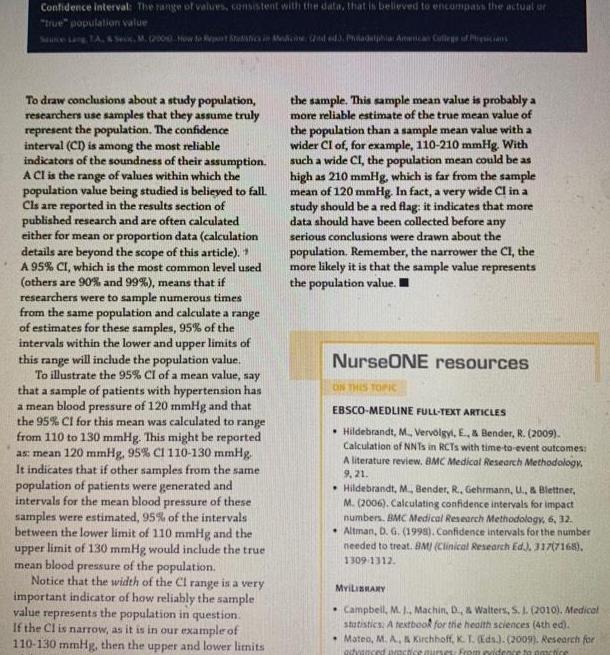
Confidence interval: The range of values, consistent with the data, that is believed to encompass the actual or "true" population value TA. & Sex, M. (2000 How to put Statistics in Medicine ind ed.). Philadelphia Arancan College of Psicians To draw conclusions about a study population, researchers use samples that they assume truly represent the population. The confidence interval (CI) is among the most reliable indicators of the soundness of their assumption. A CI is the range of values within which the population value being studied is believed to fall. Cls are reported in the results section of published research and are often calculated either for mean or proportion data (calculation details are beyond the scope of this article). A 95% CI, which is the most common level used (others are 90% and 99%), means that if researchers were to sample numerous times from the same population and calculate a range of estimates for these samples, 95% of the intervals within the lower and upper limits of this range will include the population value. To illustrate the 95% CI of a mean value, say that a sample of patients with hypertension has a mean blood pressure of 120 mmHg and that the 95% CI for this mean was calculated to range from 110 to 130 mmHg. This might be reported as: mean 120 mmHg, 95% CI 110-130 mmHg. It indicates that if other samples from the same population of patients were generated and intervals for the mean blood pressure of these samples were estimated, 95% of the intervals between the lower limit of 110 mmHg and the upper limit of 130 mmHg would include the true mean blood pressure of the population. Notice that the width of the Cl range is a very important indicator of how reliably the sample value represents the population in question. If the Cl is narrow, as it is in our example of 110-130 mmHg, then the upper and lower limits the sample. This sample mean value is probably a more reliable estimate of the true mean value of the population than a sample mean value with a wider CI of, for example, 110-210 mmHg. With such a wide Cl, the population mean could be as high as 210 mmHg, which is far from the sample mean of 120 mmHg. In fact, a very wide Cl in a study should be a red flag: it indicates that more data should have been collected before any serious conclusions were drawn about the population. Remember, the narrower the Cl, the more likely it is that the sample value represents the population value. NurseONE resources ON THIS TOPIC EBSCO-MEDLINE FULL-TEXT ARTICLES Hildebrandt, M., Vervolgyi, E., & Bender, R. (2009). Calculation of NNTs in RCTs with time-to-event outcomes: A literature review. BMC Medical Research Methodology, 9.21. Hildebrandt, M., Bender, R., Gehrmann, U., & Blettner, M. (2006). Calculating confidence intervals for impact numbers. BMC Medical Research Methodology, 6, 32. Altman, D. G. (1998). Confidence intervals for the number needed to treat. BMI (Clinical Research Ed.). 317(7168), 1309-1312. MYILIBRARY Campbell, M. J., Machin, D., & Walters, S. J. (2010). Medical statistics: A textbook for the health sciences (4th ed). Mateo, M. A., & Kirchhoff, K. T. (Eds.). (2009). Research for advanced practice nurses: From evidence to amctice
Step by Step Solution
There are 3 Steps involved in it

Get step-by-step solutions from verified subject matter experts
 Study Help