







Question: confirmation process and customer satisfaction. Question 7 ( 7 . 1 ) In a client / server system, what is the purpose of a timeout
confirmation process and customer satisfaction.
Question
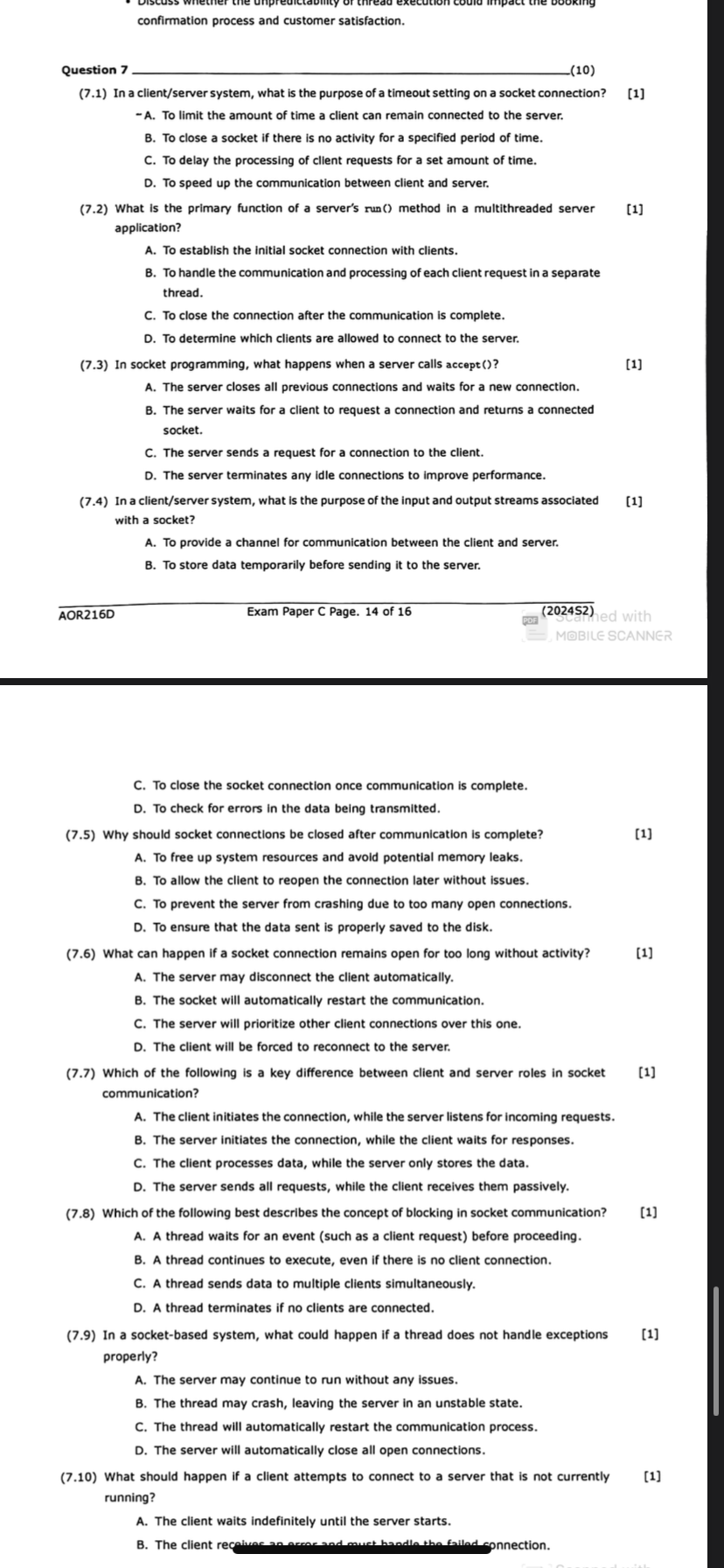
In a clientserver system, what is the purpose of a timeout setting on a socket connection?
A To limit the amount of time a client can remain connected to the server.
B To close a socket if there is no activity for a specified period of time.
C To delay the processing of cllent requests for a set amount of time.
D To speed up the communication between client and server.
What is the primary function of a server's run method in a multithreaded server
application?
A To establish the initial socket connection with clients.
B To handle the communication and processing of each client request in a separate thread.
C To close the connection after the communication is complete.
D To determine which clients are allowed to connect to the server.
In socket programming, what happens when a server calls accept
A The server closes all previous connections and waits for a new connection.
B The server waits for a client to request a connection and returns a connected socket.
C The server sends a request for a connection to the client.
D The server terminates any idle connections to improve performance.
In a clientserver system, what is the purpose of the input and output streams associated
with a socket?
A To provide a channel for communication between the client and server.
B To store data temporarily before sending it to the server.
C To close the socket connection once communication is complete.
D To check for errors in the data being transmitted.
Why should socket connections be closed after communication is complete?
A To free up system resources and avold potential memory leaks.
B To allow the client to reopen the connection later without issues.
C To prevent the server from crashing due to too many open connections.
D To ensure that the data sent is properly saved to the disk.
What can happen if a socket connection remains open for too long without activity?
A The server may disconnect the client automatically.
B The socket will automatically restart the communication.
C The server will prioritize other client connections over this one.
D The client will be forced to reconnect to the server.
Which of the following is a key difference between client and server roles in socket
communication?
A The client initiates the connection, while the server listens for incoming requests.
B The server initiates the connection, while the client waits for responses.
C The client processes data, while the server only stores the data.
D The server sends all requests, while the client receives them passively.
Which of the following best describes the concept of blocking in socket communication?
A A thread waits for an event such as a client request before proceeding.
B A thread continues to execute, even if there is no client connection.
C A thread sends data to multiple clients simultaneously.
D A thread terminates if no clients are connected.
In a socketbased system, what could happen if a thread does not handle exceptions
properly?
A The server may continue to run without any issues.
B The thread may crash, leaving the server in an unstable state.
C The thread will automatically restart the communication process.
D The server will automatically close all open connections.
What should happen if a client attempts to connect to a server that is not currently
running?
A The client waits indefinitely until the server starts.
Step by Step Solution
There are 3 Steps involved in it
1 Expert Approved Answer
Step: 1 Unlock

Question Has Been Solved by an Expert!
Get step-by-step solutions from verified subject matter experts
Step: 2 Unlock
Step: 3 Unlock
 Study Help