







Question: Consequence Analysis In a devolatilizer, a solvent ( 60% cyclohexane and 40% pentane) is removed from a polymer and sent to the solvent recycle section
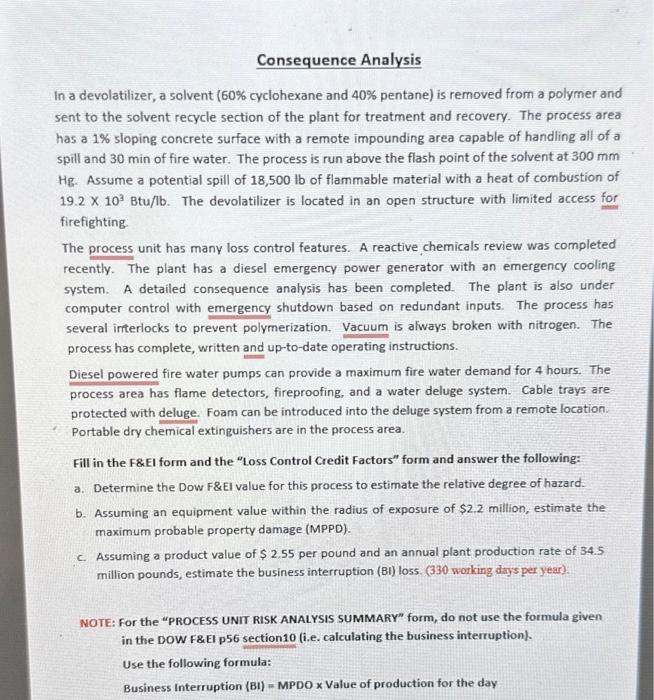
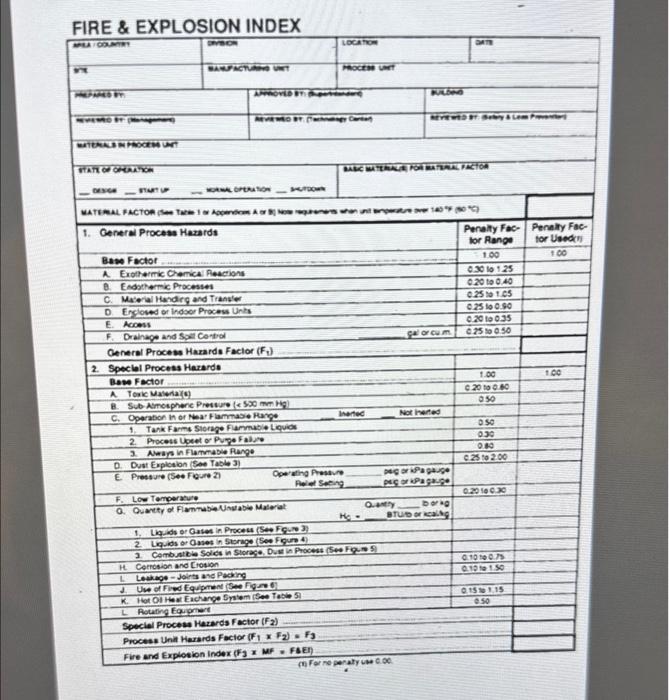
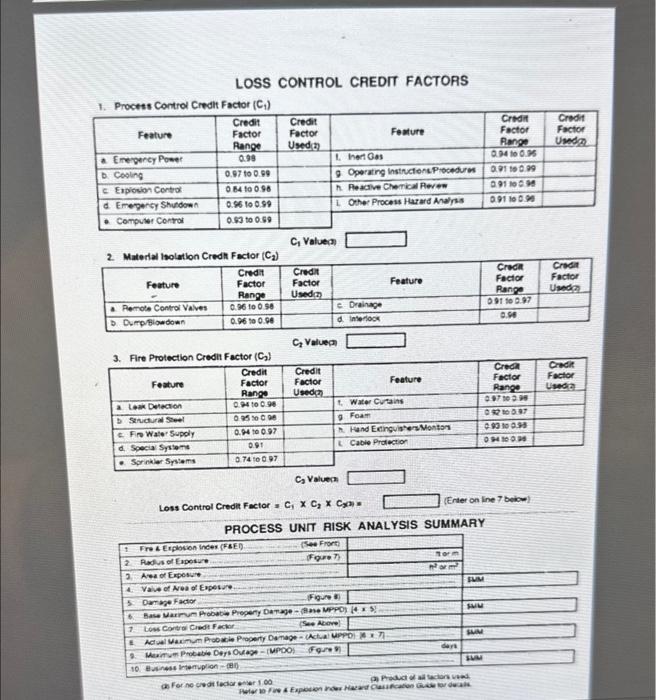
Consequence Analysis In a devolatilizer, a solvent ( 60% cyclohexane and 40% pentane) is removed from a polymer and sent to the solvent recycle section of the plant for treatment and recovery. The process area has a 1% sloping concrete surface with a remote impounding area capable of handling all of a spill and 30min of fire water. The process is run above the flash point of the solvent at 300mm Hg. Assume a potential spill of 18,500lb of flammable material with a heat of combustion of 19.2103Btu/lb. The devolatilizer is located in an open structure with limited access for firefighting. The process unit has many loss control features. A reactive chemicals review was completed recently. The plant has a diesel emergency power generator with an emergency cooling system. A detailed consequence analysis has been completed. The plant is also under computer control with emergency shutdown based on redundant inputs. The process has several irterlocks to prevent polymerization, Vacuum is always broken with nitrogen. The process has complete, written and up-to-date operating instructions. Diesel powered fire water pumps can provide a maximum fire water demand for 4 hours. The process area has flame detectors, fireproofing, and a water deluge system. Cable trays are protected with deluge. Foam can be introduced into the deluge system from a remote location. Portable dry chemical extinguishers are in the process area. Fill in the F\&El form and the "Loss Control Credit Factors" form and answer the following: a. Determine the Dow F\&EI value for this process to estimate the relative degree of hazard. b. Assuming an equipment value within the radius of exposure of $2.2 million, estimate the maximum probable property damage (MPPD). c. Assuming a product value of $2.55 per pound and an annual plant production rate of 34.5 million pounds, estimate the business interruption (BI) loss. (330 working days per year). NOTE: For the "PROCESS UNIT RISK ANALYSIS SUMMARY" form, do not use the formula given in the DOW F\&EI p56 section10 (i.e. calculating the business interruption). Use the following formula: Business interruption (BI) = MPDO Value of production for the day 1 LOSS CONTROL CREDIT FACTOFS C1 Valuen Loss Control Crede Factor =C1C2Cx= (Erster on ine 7. PROCESS UNIT AISK ANALYSIS SUMMARY an For ne crat fectar awier 1.00
Step by Step Solution
There are 3 Steps involved in it

Get step-by-step solutions from verified subject matter experts
 Study Help