







Question: Consider 3 payment schedules (3 loans) - (i) pay $2,000 after 6 months and $4,000 at the end of the year. (ii) pay $4,000
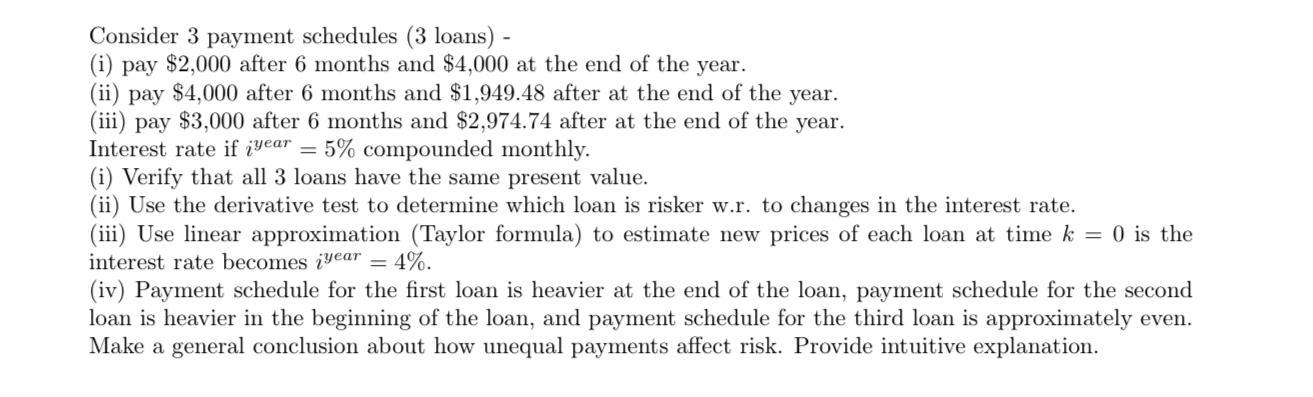
Consider 3 payment schedules (3 loans) - (i) pay $2,000 after 6 months and $4,000 at the end of the year. (ii) pay $4,000 after 6 months and $1,949.48 after at the end of the year. (iii) pay $3,000 after 6 months and $2,974.74 after at the end of the year. Interest rate if year = 5% compounded monthly. (i) Verify that all 3 loans have the same present value. (ii) Use the derivative test to determine which loan is risker w.r. to changes in the interest rate. (iii) Use linear approximation (Taylor formula) to estimate new prices of each loan at time k = 0 is the interest rate becomes year = 4%. (iv) Payment schedule for the first loan is heavier at the end of the loan, payment schedule for the second loan is heavier in the beginning of the loan, and payment schedule for the third loan is approximately even. Make a general conclusion about how unequal payments affect risk. Provide intuitive explanation.
Step by Step Solution
3.58 Rating (159 Votes )
There are 3 Steps involved in it
i All three loans have the same present value ii The first loan is riskier with respect to changes i... View full answer

Get step-by-step solutions from verified subject matter experts
 Study Help