



Question: Consider a 1 kg brick on a ledge 10 m above the surface of the earth. If the brick fell, use Newton's universal law of
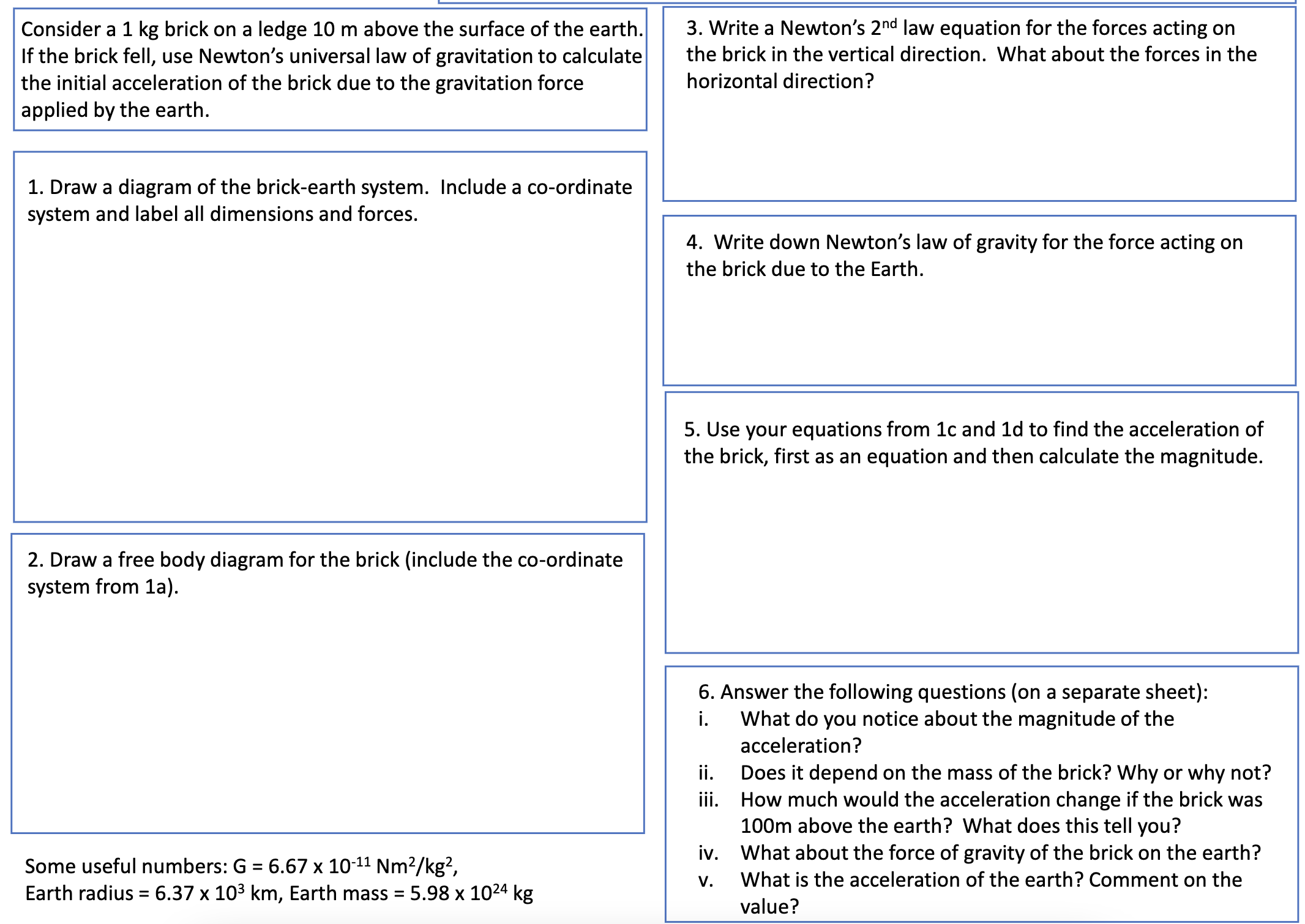
Consider a 1 kg brick on a ledge 10 m above the surface of the earth. If the brick fell, use Newton's universal law of gravitation to calculate the initial acceleration of the brick due to the gravitation force applied by the earth. 1. Draw a diagram of the brick-earth system. Include a co-ordinate system and label all dimensions and forces. 2. Draw a free body diagram for the brick (include the co-ordinate system from 1a). Some useful numbers: G = 6.67 x 10'11 Nm2/kg2, Earth radius = 6.37 x 10³ km, Earth mass = 5.98 x 1024 kg 3. Write a Newton's 2"d law equation for the forces acting on the brick in the vertical direction. What about the forces in the horizontal direction? 4. Write down Newton's law of gravity for the force acting on the brick due to the Earth. 5. Use your equations from 1c and id to find the acceleration of the brick, first as an equation and then calculate the magnitude. 6. Answer the following questions (on a separate sheet): i. What do you notice about the magnitude ofthe acceleration? Does it depend on the mass of the brick? Why or why not? How much would the acceleration change if the brick was 100m above the earth? What does this tell you? What about the force of gravity of the brick on the earth? What is the acceleration of the earth? Comment on the value
Step by Step Solution
There are 3 Steps involved in it

Get step-by-step solutions from verified subject matter experts