







Question: Consider a 2-dimensional magnet on a Square lattice. Each spin has z=4 nearest neighbors. BUT the system is NOT described by the usual Ising model
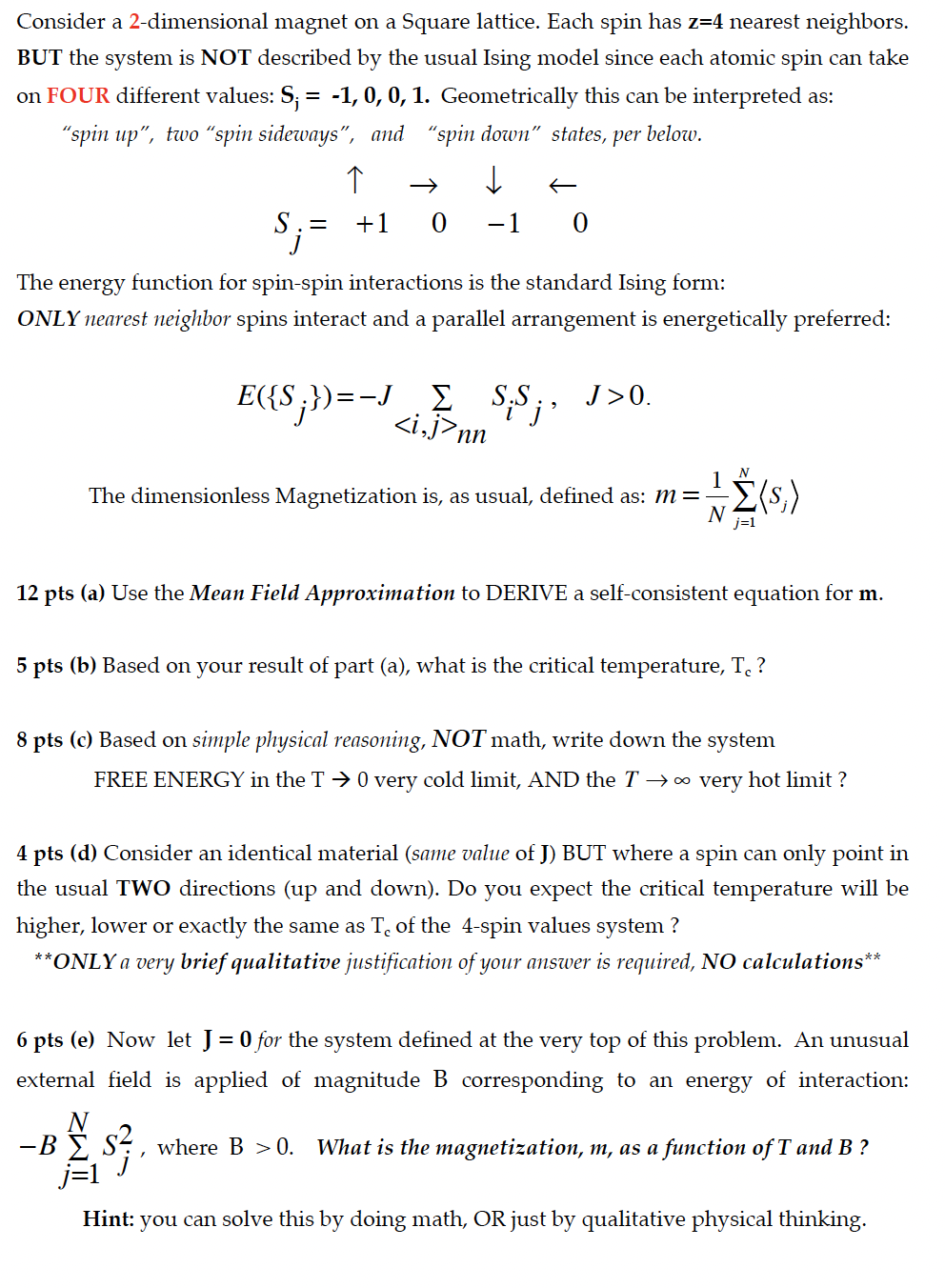
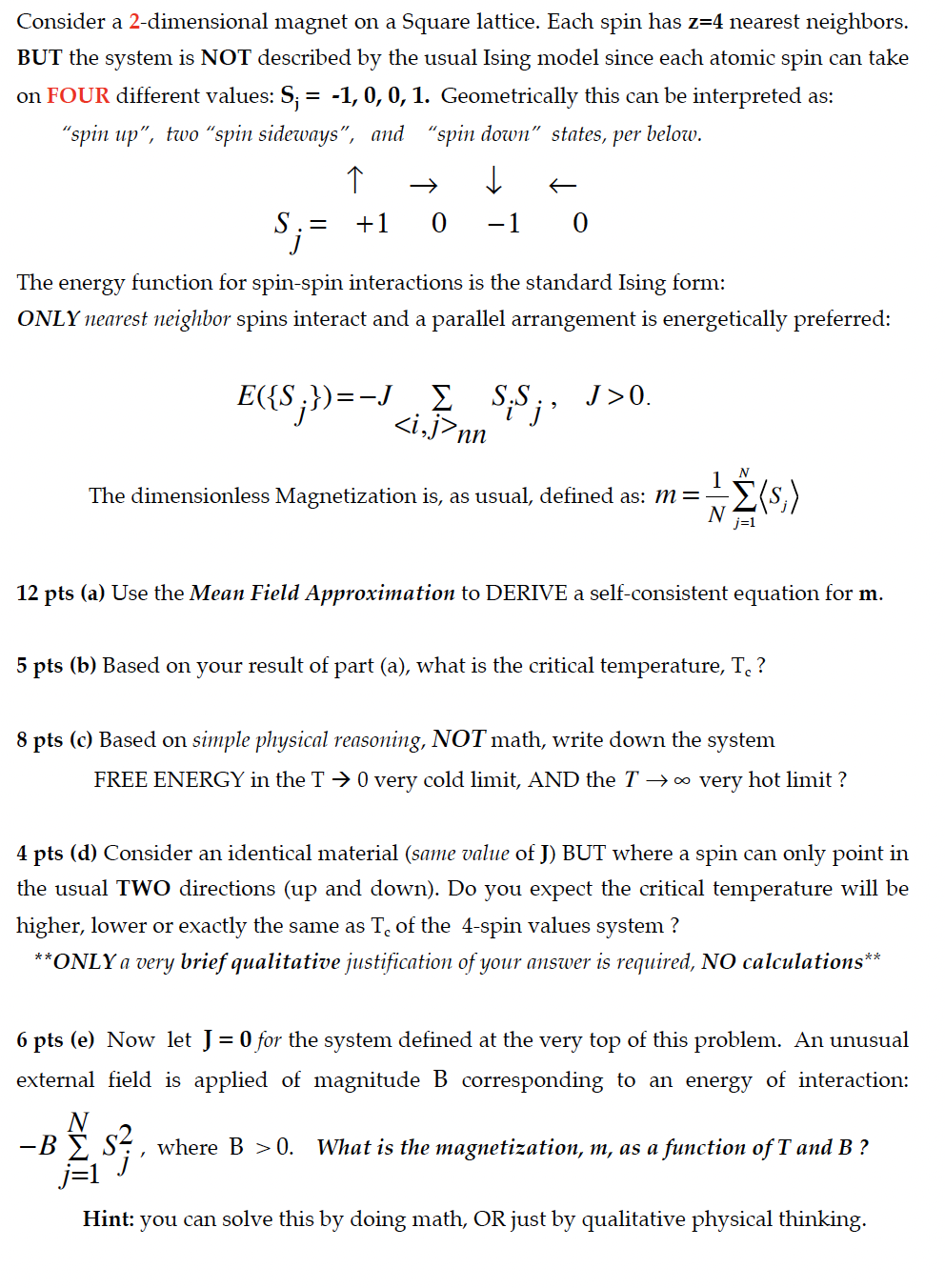
Consider a 2-dimensional magnet on a Square lattice. Each spin has z=4 nearest neighbors. BUT the system is NOT described by the usual Ising model since each atomic spin can take on FOUR different values: S; = -1, 0, 0, 1. Geometrically this can be interpreted as: "spin up", two "spin sideways", and "spin down" states, per below. S ; = +1 0 The energy function for spin-spin interactions is the standard Ising form: ONLY nearest neighbor spins interact and a parallel arrangement is energetically preferred: E(S; ))=-J E S.S; , J >0. nn The dimensionless Magnetization is, as usual, defined as: m = LE( S , ) 12 pts (a) Use the Mean Field Approximation to DERIVE a self-consistent equation for m. 5 pts (b) Based on your result of part (a), what is the critical temperature, T. ? 8 pts (c) Based on simple physical reasoning, NOT math, write down the system FREE ENERGY in the T -> 0 very cold limit, AND the T -> co very hot limit ? 4 pts (d) Consider an identical material (same value of J) BUT where a spin can only point in the usual TWO directions (up and down). Do you expect the critical temperature will be higher, lower or exactly the same as To of the 4-spin values system ? **ONLY a very brief qualitative justification of your answer is required, NO calculations** 6 pts (e) Now let J = 0 for the system defined at the very top of this problem. An unusual external field is applied of magnitude B corresponding to an energy of interaction: N -BE where B > 0. What is the magnetization, m, as a function of T and B ? j=1 Hint: you can solve this by doing math, OR just by qualitative physical thinking
Step by Step Solution
There are 3 Steps involved in it

Get step-by-step solutions from verified subject matter experts
 Study Help