







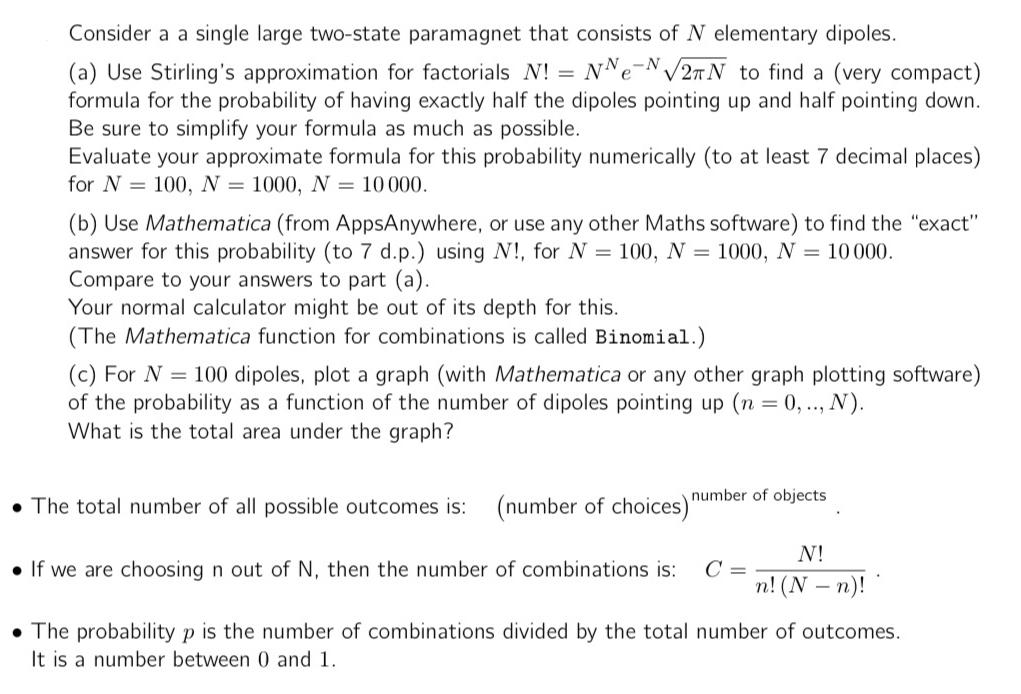
Question: Consider a a single large two - state paramagnet that consists of N elementary dipoles. ( a ) Use Stirling's approximation for factorials N N
Consider a a single large twostate paramagnet that consists of elementary dipoles.
a Use Stirling's approximation for factorials to find a very compact formula for the probability of having exactly half the dipoles pointing up and half pointing down. Be sure to simplify your formula as much as possible.
Evaluate your approximate formula for this probability numerically to at least decimal places for
b Use Mathematica from AppsAnywhere, or use any other Maths software to find the "exact" answer for this probability to dp using for
Compare to your answers to part a
Your normal calculator might be out of its depth for this.
The Mathematica function for combinations is called Binomial.
c For dipoles, plot a graph with Mathematica or any other graph plotting software of the probability as a function of the number of dipoles pointing up
What is the total area under the graph?
The total number of all possible outcomes is: number of choicesnumber objects
If we are choosing out of then the number of combinations is:
The probability is the number of combinations divided by the total number of outcomes. It is a number between and
Step by Step Solution
There are 3 Steps involved in it
1 Expert Approved Answer
Step: 1 Unlock

Question Has Been Solved by an Expert!
Get step-by-step solutions from verified subject matter experts
Step: 2 Unlock
Step: 3 Unlock
 Study Help