







Question: Consider a battery using a conversion reaction involving CoO as the cathode as shown below, where A=Li or Na: CoO+2ACo+A2O (a) Write the balanced anodic
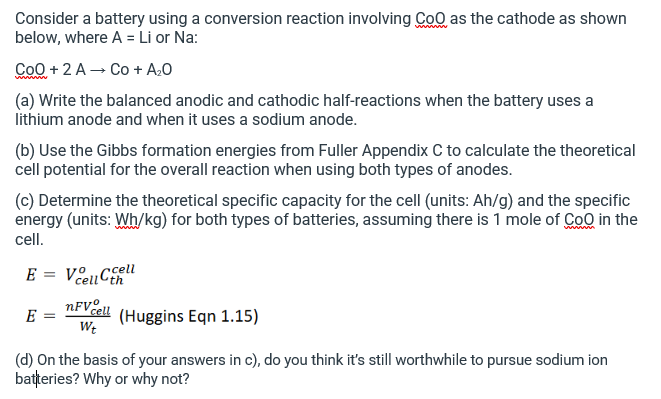
Consider a battery using a conversion reaction involving CoO as the cathode as shown below, where A=Li or Na: CoO+2ACo+A2O (a) Write the balanced anodic and cathodic half-reactions when the battery uses a lithium anode and when it uses a sodium anode. (b) Use the Gibbs formation energies from Fuller Appendix C to calculate the theoretical cell potential for the overall reaction when using both types of anodes. (c) Determine the theoretical specific capacity for the cell (units: Ah/g) and the specific energy (units: Wh/kg ) for both types of batteries, assuming there is 1 mole of CoO in the cell. EE=VcelloCthcell=WtnFVcello(HugginsEqn1.15) (d) On the basis of your answers in c), do you think it's still worthwhile to pursue sodium ion batteries? Why or why not
Step by Step Solution
There are 3 Steps involved in it

Get step-by-step solutions from verified subject matter experts
 Study Help