







Question: Consider a borrower who chooses current consumption (c), future consumption (c') and borrowing (s 0 as given. In addition to the endowments, the consumer has
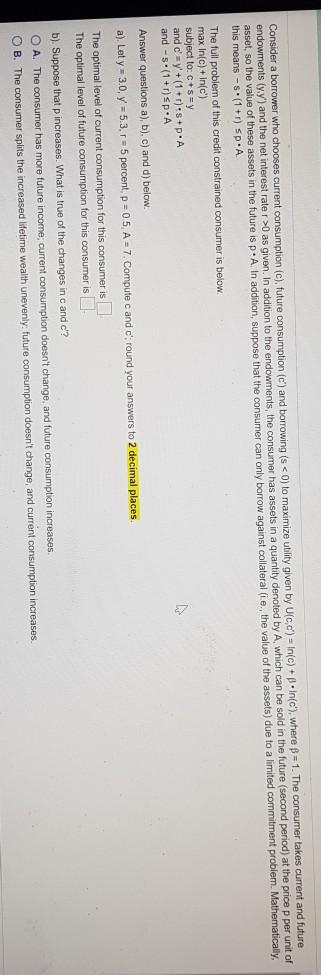
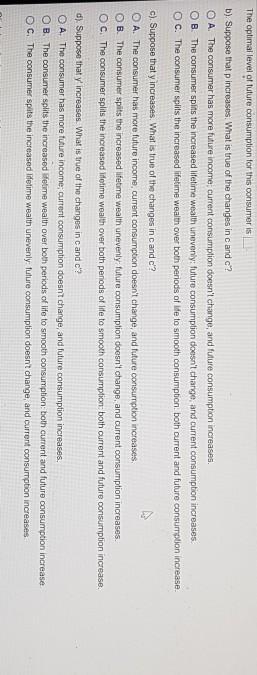
Consider a borrower who chooses current consumption (c), future consumption (c') and borrowing (s 0 as given. In addition to the endowments, the consumer has assets in a quantity denoted by A, which can be sold in the future (second period) at the price p per unit of asset, so the value of these assets in the future is p. A In addition, suppose that the consumer can only borrow against collateral fi.e. the value of the assets) due to a limited commitment problem. Mathematically, this means -S. (1+r) Sp.A The full problem of this credit constrained consumer is below. max Inc) + Inc") subject to: C+s=y and c'=y'+(1+r) s.p.A and - 5.(1+1) sp.A Answer questions a), b), c) and d) below. a). Let y = 3.0, y = 53,r- 5 percent, p=0.5, A = 7. Compute c and c': round your answers to 2 decimal places The optimal level of current consumption for this consumer is The optimal level of future consumption for this consumer is b). Suppose that p increases. What is true of the changes in c and c? OA. The consumer has more future income, current consumption doesn't change, and future consumption increases OB. The consumer splits the increased lifetime wealth unevenly future consumption doesn't change, and current consumption increases The optimal level of future consumption for this consumer is b). Suppose that p increases What is true of the changes in cand c? O A. The consumer has more future income, current consumption doesn't change, and future consumption increases OB. The consumer spits the increased lifetime wealth unevenly: future consumption doesn't change and current consumption increases O C. The consumer splits the increased lifetime wealth over both periods of life to smooth consumption both current and future consumption increase c). Suppose that y increases. What is true of the changes in cand d? O A. The consumer has more future income, current consumption doesn't change, and future consumption increases B. The consumer spits the increased lifetime wealth unevenly future consumption doesn't change, and current consumption increases OC. The consumer splits the increased lifetime wealth over both periods of life to smooth consumption: both current and future consumption increase. d) Suppose that y increases. What is true of the changes in cand c? O A The consumer has more future income: current consumption doesn't change, and future consumption increases OB. The consumer splits the increased feume wealth over both periods of life to smooth consumption: both current and future consumption increase OC. The consumer splits the increased lifetime wealth unevenly future consumption doesn't change, and current consumption increases Consider a borrower who chooses current consumption (c), future consumption (c') and borrowing (s 0 as given. In addition to the endowments, the consumer has assets in a quantity denoted by A, which can be sold in the future (second period) at the price p per unit of asset, so the value of these assets in the future is p. A In addition, suppose that the consumer can only borrow against collateral fi.e. the value of the assets) due to a limited commitment problem. Mathematically, this means -S. (1+r) Sp.A The full problem of this credit constrained consumer is below. max Inc) + Inc") subject to: C+s=y and c'=y'+(1+r) s.p.A and - 5.(1+1) sp.A Answer questions a), b), c) and d) below. a). Let y = 3.0, y = 53,r- 5 percent, p=0.5, A = 7. Compute c and c': round your answers to 2 decimal places The optimal level of current consumption for this consumer is The optimal level of future consumption for this consumer is b). Suppose that p increases. What is true of the changes in c and c? OA. The consumer has more future income, current consumption doesn't change, and future consumption increases OB. The consumer splits the increased lifetime wealth unevenly future consumption doesn't change, and current consumption increases The optimal level of future consumption for this consumer is b). Suppose that p increases What is true of the changes in cand c? O A. The consumer has more future income, current consumption doesn't change, and future consumption increases OB. The consumer spits the increased lifetime wealth unevenly: future consumption doesn't change and current consumption increases O C. The consumer splits the increased lifetime wealth over both periods of life to smooth consumption both current and future consumption increase c). Suppose that y increases. What is true of the changes in cand d? O A. The consumer has more future income, current consumption doesn't change, and future consumption increases B. The consumer spits the increased lifetime wealth unevenly future consumption doesn't change, and current consumption increases OC. The consumer splits the increased lifetime wealth over both periods of life to smooth consumption: both current and future consumption increase. d) Suppose that y increases. What is true of the changes in cand c? O A The consumer has more future income: current consumption doesn't change, and future consumption increases OB. The consumer splits the increased feume wealth over both periods of life to smooth consumption: both current and future consumption increase OC. The consumer splits the increased lifetime wealth unevenly future consumption doesn't change, and current consumption increases
Step by Step Solution
There are 3 Steps involved in it

Get step-by-step solutions from verified subject matter experts
 Study Help