







Question: Consider a Carnot heat engine placed between a finite thermal energy source and an infinite thermal energy sink. Since the temperature of the thermal
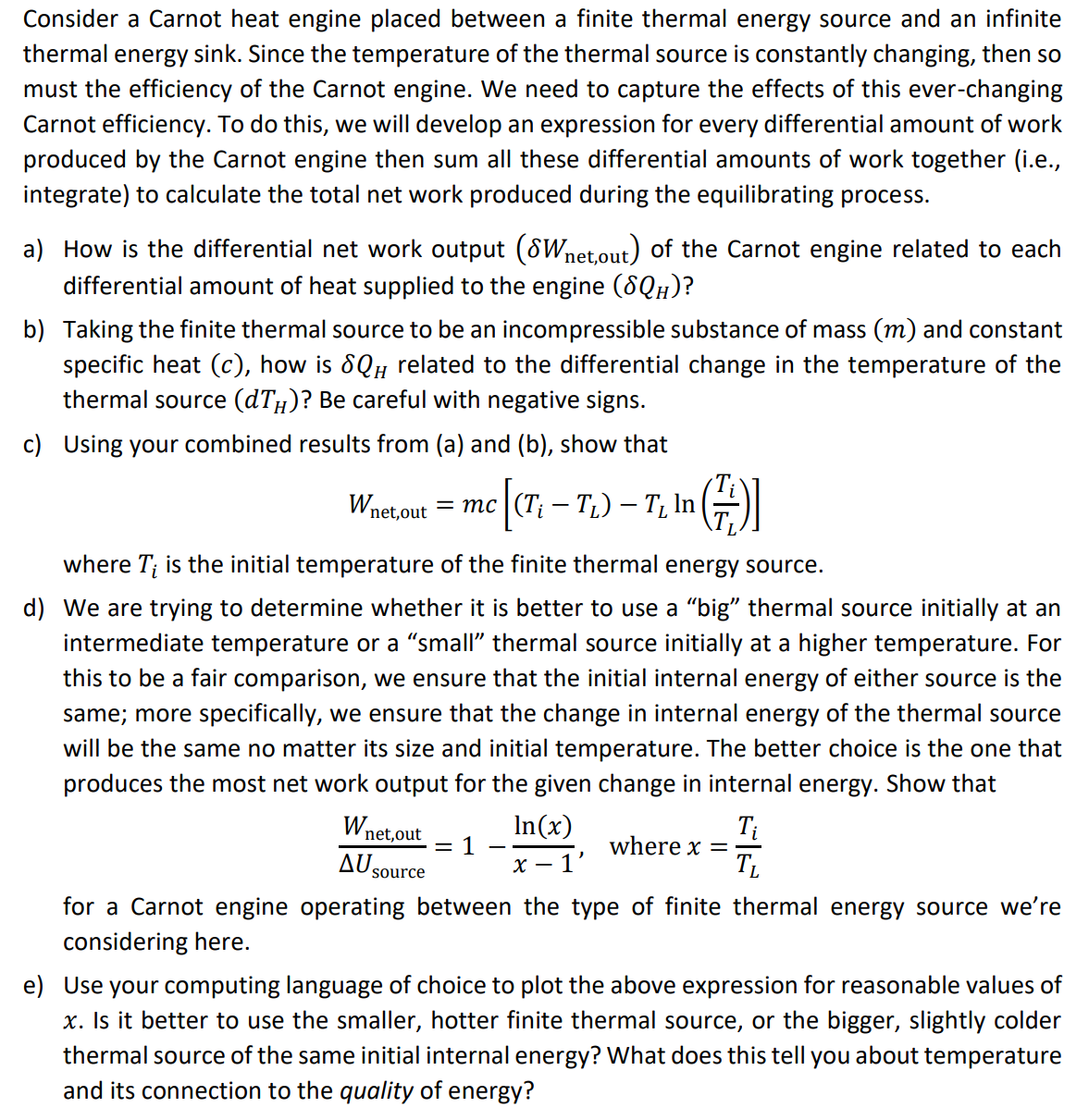
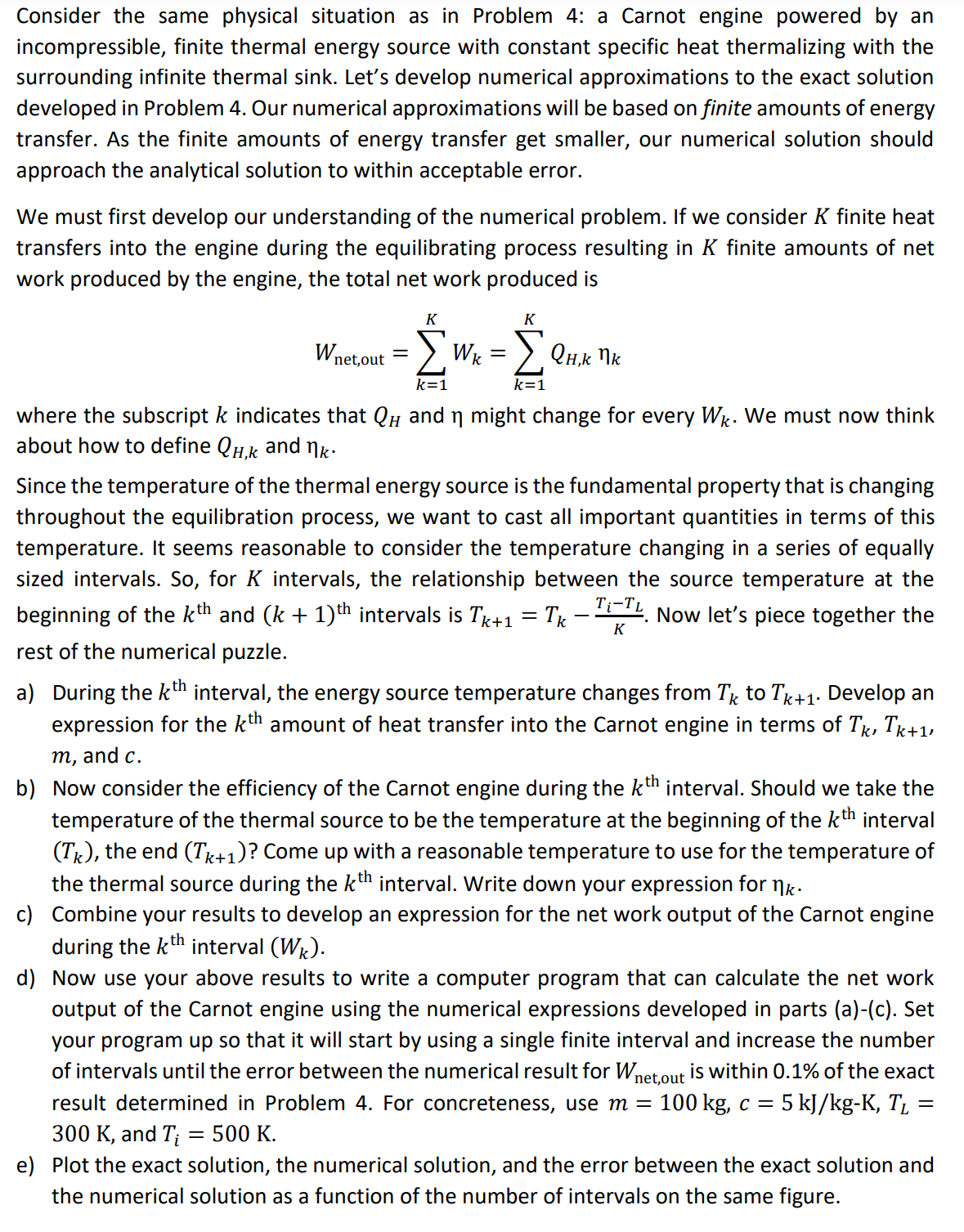
Consider a Carnot heat engine placed between a finite thermal energy source and an infinite thermal energy sink. Since the temperature of the thermal source is constantly changing, then so must the efficiency of the Carnot engine. We need to capture the effects of this ever-changing Carnot efficiency. To do this, we will develop an expression for every differential amount of work produced by the Carnot engine then sum all these differential amounts of work together (i.e., integrate) to calculate the total net work produced during the equilibrating process. a) How is the differential net work output (SW net,out) of the Carnot engine related to each differential amount of heat supplied to the engine (SQH)? b) Taking the finite thermal source to be an incompressible substance of mass (m) and constant specific heat (c), how is 8QH related to the differential change in the temperature of the thermal source (dT)? Be careful with negative signs. c) Using your combined results from (a) and (b), show that : [(T; T) - - Wnet,out mc (T; T) T In where T is the initial temperature of the finite thermal energy source. d) We are trying to determine whether it is better to use a "big" thermal source initially at an intermediate temperature or a small thermal source initially at a higher temperature. For this to be a fair comparison, we ensure that the initial internal energy of either source is the same; more specifically, we ensure that the change in internal energy of the thermal source will be the same no matter its size and initial temperature. The better choice is the one that produces the most net work output for the given change in internal energy. Show that Wnet,out AU source = 1 - In(x) x-1' Ti where x = TL for a Carnot engine operating between the type of finite thermal energy source we're considering here. e) Use your computing language of choice to plot the above expression for reasonable values of x. Is it better to use the smaller, hotter finite thermal source, or the bigger, slightly colder thermal source of the same initial internal energy? What does this tell you about temperature and its connection to the quality of energy? Consider the same physical situation as in Problem 4: a Carnot engine powered by an incompressible, finite thermal energy source with constant specific heat thermalizing with the surrounding infinite thermal sink. Let's develop numerical approximations to the exact solution developed in Problem 4. Our numerical approximations will be based on finite amounts of energy transfer. As the finite amounts of energy transfer get smaller, our numerical solution should approach the analytical solution to within acceptable error. We must first develop our understanding of the numerical problem. If we consider K finite heat transfers into the engine during the equilibrating process resulting in K finite amounts of net work produced by the engine, the total net work produced is Wnet,out K K Wk = QH, K k=1 k=1 where the subscript k indicates that QH and might change for every Wk. We must now think n about how to define Q,k and k Since the temperature of the thermal energy source is the fundamental property that is changing throughout the equilibration process, we want to cast all important quantities in terms of this temperature. It seems reasonable to consider the temperature changing in a series of equally sized intervals. So, for K intervals, the relationship between the source temperature at the beginning of the kth and (k + 1) th intervals is Tk+1 = Tk Ti-TL. Now let's piece together the rest of the numerical puzzle. K a) During the kth interval, the energy source temperature changes from Tk to Tk+1. Develop an expression for the kth amount of heat transfer into the Carnot engine in terms of Tk, Tk+1, m, and c. b) Now consider the efficiency of the Carnot engine during the kth interval. Should we take the temperature of the thermal source to be the temperature at the beginning of the kth interval (Tk), the end (Tk+1)? Come up with a reasonable temperature to use for the temperature of the thermal source during the kth interval. Write down your expression for k. c) Combine your results to develop an expression for the net work output of the Carnot engine during the kth interval (Wk). d) Now use your above results to write a computer program that can calculate the net work output of the Carnot engine using the numerical expressions developed in parts (a)-(c). Set your program up so that it will start by using a single finite interval and increase the number of intervals until the error between the numerical result for W is within 0.1% of the exact result determined in Problem 4. For concreteness, use m = 100 kg, c = 5 kJ/kg-K, T = 300 K, and T = 500 K. net,out - e) Plot the exact solution, the numerical solution, and the error between the exact solution and the numerical solution as a function of the number of intervals on the same figure.
Step by Step Solution
There are 3 Steps involved in it

Get step-by-step solutions from verified subject matter experts
 Study Help