







Question: Consider a class named Course that has two attributes: CourselD and CourseName. A) Explain the steps for creating a Java application that provides all CRUD
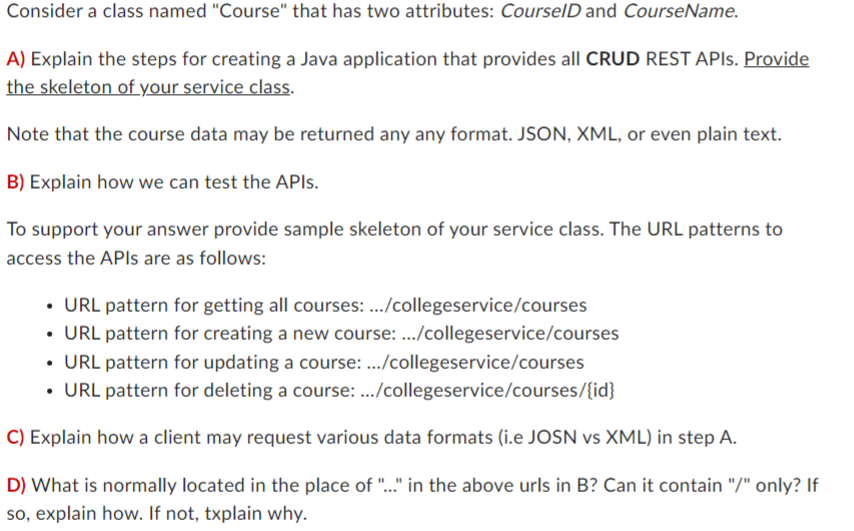
Consider a class named "Course" that has two attributes: CourselD and CourseName. A) Explain the steps for creating a Java application that provides all CRUD REST APIs. Provide the skeleton of your service class. Note that the course data may be returned any any format. JSON, XML, or even plain text. B) Explain how we can test the APIs. To support your answer provide sample skeleton of your service class. The URL patterns to access the APIs are as follows: - URL pattern for getting all courses: .../collegeservice/courses - URL pattern for creating a new course: .../collegeservice/courses - URL pattern for updating a course: .../collegeservice/courses - URL pattern for deleting a course: .../collegeservice/courses/\{id\} C) Explain how a client may request various data formats (i.e JOSN vs XML) in step A. D) What is normally located in the place of "..." in the above urls in B? Can it contain "/" only? If so, explain how. If not, txplain why. Consider a class named "Course" that has two attributes: CourselD and CourseName. A) Explain the steps for creating a Java application that provides all CRUD REST APIs. Provide the skeleton of your service class. Note that the course data may be returned any any format. JSON, XML, or even plain text. B) Explain how we can test the APIs. To support your answer provide sample skeleton of your service class. The URL patterns to access the APIs are as follows: - URL pattern for getting all courses: .../collegeservice/courses - URL pattern for creating a new course: .../collegeservice/courses - URL pattern for updating a course: .../collegeservice/courses - URL pattern for deleting a course: .../collegeservice/courses/\{id\} C) Explain how a client may request various data formats (i.e JOSN vs XML) in step A. D) What is normally located in the place of "..." in the above urls in B? Can it contain "/" only? If so, explain how. If not, txplain why
Step by Step Solution
There are 3 Steps involved in it

Get step-by-step solutions from verified subject matter experts
 Study Help