



Question: Consider a couple whose behaviour follows the unitary household model. Their preferences can be represented by the utility function: U(CM; CH) = min (CM, CH),
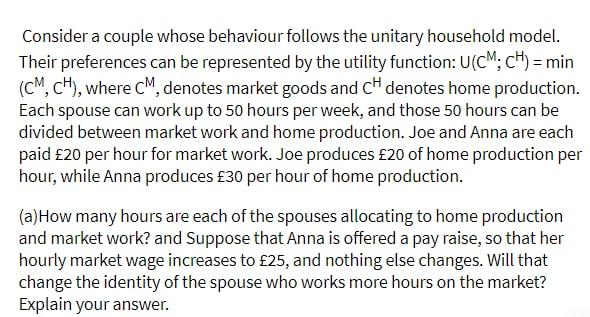
Consider a couple whose behaviour follows the unitary household model. Their preferences can be represented by the utility function: U(CM; CH) = min (CM, CH), where CM, denotes market goods and CH denotes home production. Each spouse can work up to 50 hours per week, and those 50 hours can be divided between market work and home production. Joe and Anna are each paid 20 per hour for market work. Joe produces 20 of home production per hour, while Anna produces 30 per hour of home production. (a) How many hours are each of the spouses allocating to home production and market work? and Suppose that Anna is offered a pay raise, so that her hourly market wage increases to 25, and nothing else changes. Will that change the identity of the spouse who works more hours on the market? Explain your answer. Consider a couple whose behaviour follows the unitary household model. Their preferences can be represented by the utility function: U(CM; CH) = min (CM, CH), where CM, denotes market goods and CH denotes home production. Each spouse can work up to 50 hours per week, and those 50 hours can be divided between market work and home production. Joe and Anna are each paid 20 per hour for market work. Joe produces 20 of home production per hour, while Anna produces 30 per hour of home production. (a) How many hours are each of the spouses allocating to home production and market work? and Suppose that Anna is offered a pay raise, so that her hourly market wage increases to 25, and nothing else changes. Will that change the identity of the spouse who works more hours on the market? Explain your
Step by Step Solution
There are 3 Steps involved in it

Get step-by-step solutions from verified subject matter experts