







Question: Consider a directed graph on n vertices, where each vertex has exactly one outgoing edge. This graph consists of a collection of cycles as well
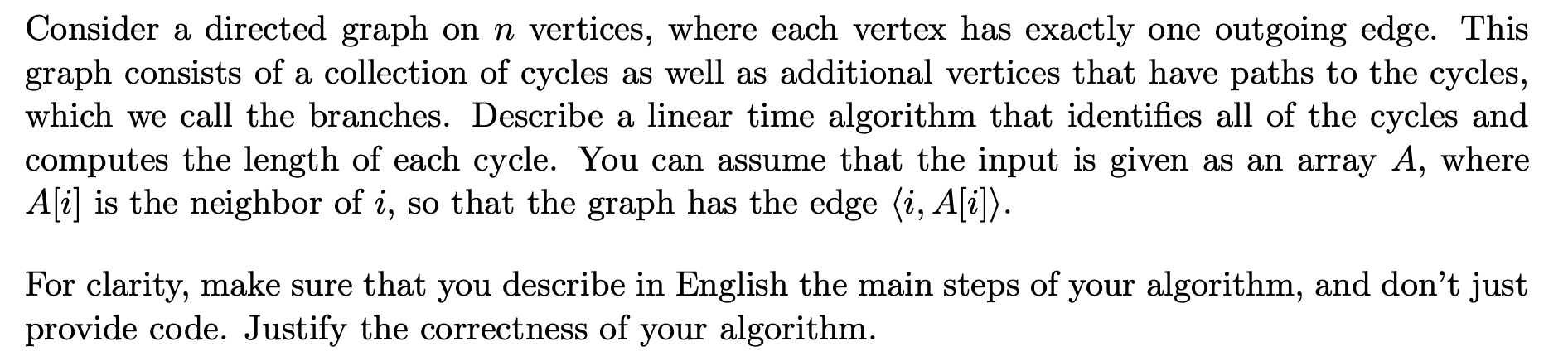
Consider a directed graph on n vertices, where each vertex has exactly one outgoing edge. This graph consists of a collection of cycles as well as additional vertices that have paths to the cycles, which we call the branches. Describe a linear time algorithm that identifies all of the cycles and computes the length of each cycle. You can assume that the input is given as an array A, where A[i] is the neighbor of i, so that the graph has the edge (i, A[i]). For clarity, make sure that you describe in English the main steps of your algorithm, and don't just provide code. Justify the correctness of your algorithm. Consider a directed graph on n vertices, where each vertex has exactly one outgoing edge. This graph consists of a collection of cycles as well as additional vertices that have paths to the cycles, which we call the branches. Describe a linear time algorithm that identifies all of the cycles and computes the length of each cycle. You can assume that the input is given as an array A, where A[i] is the neighbor of i, so that the graph has the edge (i, A[i]). For clarity, make sure that you describe in English the main steps of your algorithm, and don't just provide code. Justify the correctness of your algorithm
Step by Step Solution
There are 3 Steps involved in it

Get step-by-step solutions from verified subject matter experts
 Study Help