







Question: Consider a disk drive that can complete a normal read request in 10ms (). The time taken to complete requests is exponentially (poisson) distributed. During
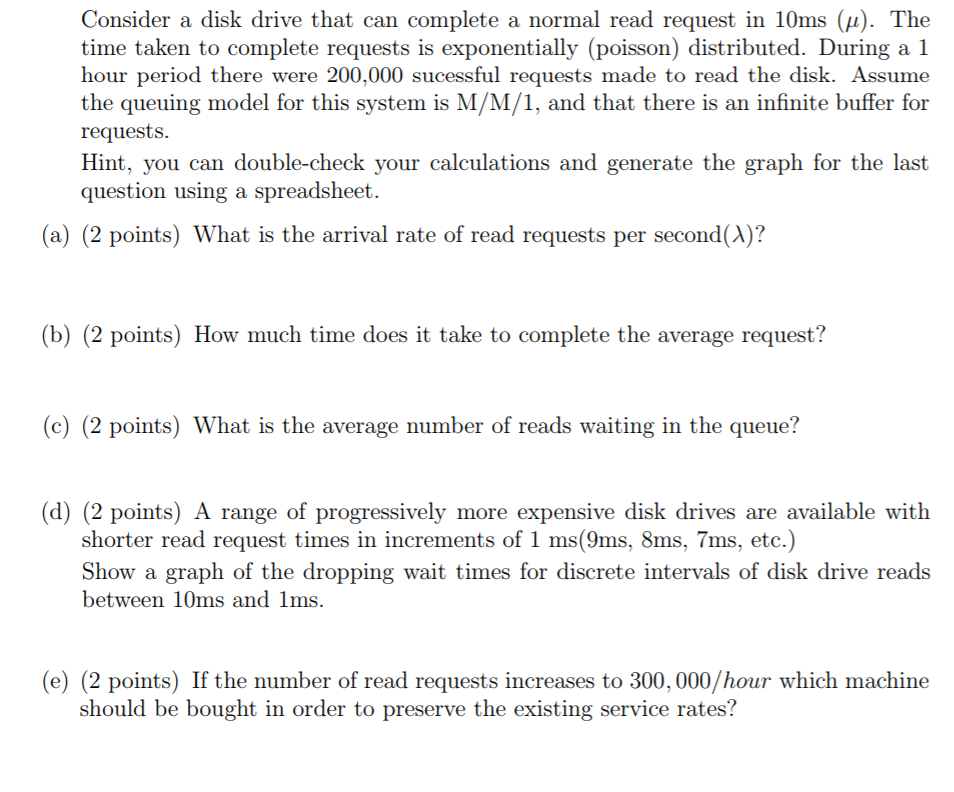
Consider a disk drive that can complete a normal read request in 10ms (). The time taken to complete requests is exponentially (poisson) distributed. During a 1 hour period there were 200,000 sucessful requests made to read the disk. Assume the queuing model for this system is M/M/1, and that there is an infinite buffer for requests. Hint, you can double-check your calculations and generate the graph for the last question using a spreadsheet. (a) (2 points) What is the arrival rate of read requests per second(A)? (b) (2 points) How much time does it take to complete the average request? (c) (2 points) What is the average number of reads waiting in the queue? (d) (2 points) A range of progressively more expensive disk drives are available with shorter read request times in increments of 1 ms(9ms, 8ms, 7ms, etc.) Show a graph of the dropping wait times for discrete intervals of disk drive reads between 10ms and lms (e) (2 points) If the number of read requests increases to 300,000/hour which machine should be bought in order to preserve the existing service rates? Consider a disk drive that can complete a normal read request in 10ms (). The time taken to complete requests is exponentially (poisson) distributed. During a 1 hour period there were 200,000 sucessful requests made to read the disk. Assume the queuing model for this system is M/M/1, and that there is an infinite buffer for requests. Hint, you can double-check your calculations and generate the graph for the last question using a spreadsheet. (a) (2 points) What is the arrival rate of read requests per second(A)? (b) (2 points) How much time does it take to complete the average request? (c) (2 points) What is the average number of reads waiting in the queue? (d) (2 points) A range of progressively more expensive disk drives are available with shorter read request times in increments of 1 ms(9ms, 8ms, 7ms, etc.) Show a graph of the dropping wait times for discrete intervals of disk drive reads between 10ms and lms (e) (2 points) If the number of read requests increases to 300,000/hour which machine should be bought in order to preserve the existing service rates
Step by Step Solution
There are 3 Steps involved in it

Get step-by-step solutions from verified subject matter experts
 Study Help