







Question: Consider a disk that is scheduled using the Elevator policy. That is , the disk head scans from the first cylinder to the last and
Consider a disk that is scheduled using the Elevator policy. That is the disk head scans from the first cylinder to the last and back repeatedly, processing IO requests along the way. However, the scan direction changes whenever there are no IO requests in the disk queue in the direction of the scan, but there are IO requests in the disk queue in the opposite direction.
Let the disk have an average rotational latency of time units and transfer time of time units per sector. The seek time for processing a request is if the request is in the same cylinder that the disk head is currently in Otherwise, let the seek time be k time units, where k is the number of cylinders travelled.
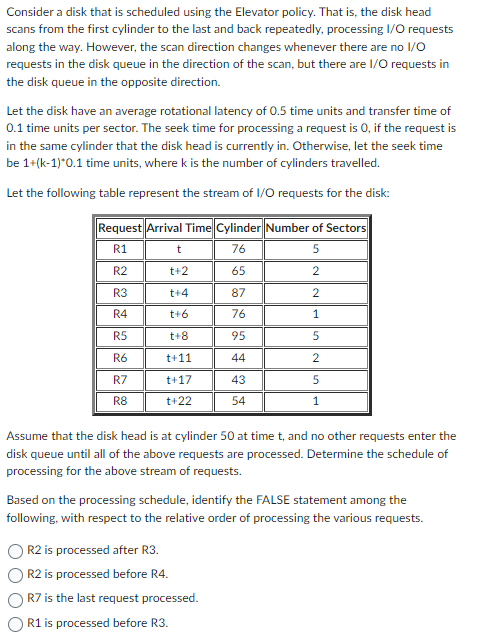
Let the following table represent the stream of IO requests for the disk:
RequestArrival TimeCylinderNumber of SectorsRtRtRtRtRtRtRtRt
Assume that the disk head is at cylinder at time t and no other requests enter the disk queue until all of the above requests are processed. Determine the schedule of processing for the above stream of requests.
Based on the processing schedule, identify the FALSE statement among the following, with respect to the relative order of processing the various requests.
Question options:
R is processed after R
R is processed before R
R is the last request processed.
R is processed before R Consider a disk that is scheduled using the Elevator policy. That is the disk head scans from the first cylinder to the last and back repeatedly, processing IO requests along the way. However, the scan direction changes whenever there are no IO requests in the disk queue in the direction of the scan, but there are IO requests in the disk queue in the opposite direction.
Let the disk have an average rotational latency of time units and transfer time of time units per sector. The seek time for processing a request is if the request is in the same cylinder that the disk head is currently in Otherwise, let the seek time be k time units, where k is the number of cylinders travelled.
Let the following table represent the stream of IO requests for the disk:
Assume that the disk head is at cylinder at time t and no other requests enter the disk queue until all of the above requests are processed. Determine the schedule of processing for the above stream of requests.
Based on the processing schedule, identify the FALSE statement among the following, with respect to the relative order of processing the various requests.
R is processed after R
R is processed before R
R is the last request processed.
R is processed before R
Step by Step Solution
There are 3 Steps involved in it
1 Expert Approved Answer
Step: 1 Unlock

Question Has Been Solved by an Expert!
Get step-by-step solutions from verified subject matter experts
Step: 2 Unlock
Step: 3 Unlock
 Study Help