







Question: Consider a file system that uses inodes to represent files. To locate the physical blocks of each file, its inode contains up to 12 direct
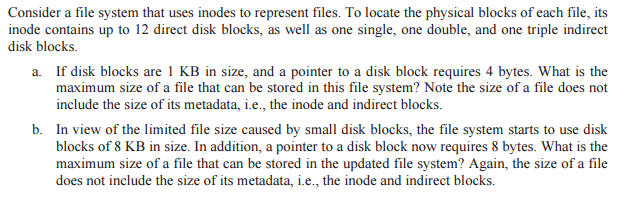
Consider a file system that uses inodes to represent files. To locate the physical blocks of each file, its inode contains up to 12 direct disk blocks, as well as one single, one double, and one triple indirect disk blocks. a. If disk blocks are 1 KB in size, and a pointer to a disk block requires 4 bytes. What is the maximum size of a file that can be stored in this file system? b. In view of the limited file size caused by small disk blocks, the file system starts to use disk blocks of 8 KB in size. In addition, a pointer to a disk block now requires 8 bytes. What is the maximum size of a file that can be stored in the updated file system? Again, the size of a file does not include the size of its metadata, i.e., the inode and indirect blocks
Step by Step Solution
There are 3 Steps involved in it

Get step-by-step solutions from verified subject matter experts
 Study Help