



Question: Consider a firm having a production technology that is represented by the following production function: 0(21, 22) = log(1+ 21.22), where log denotes the natural
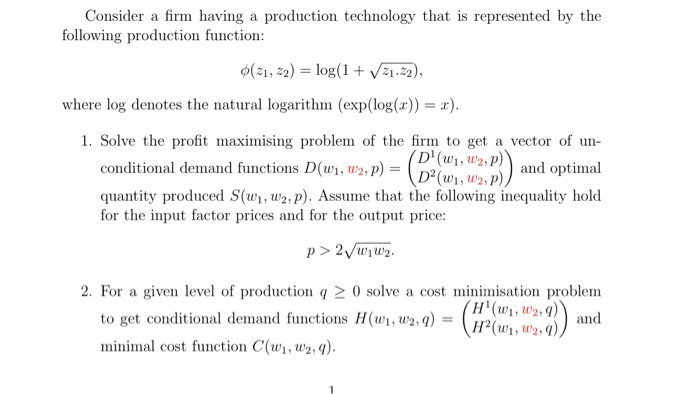
Consider a firm having a production technology that is represented by the following production function: 0(21, 22) = log(1+ 21.22), where log denotes the natural logarithm (exp(log(x)) = x). 1. Solve the profit maximising problem of the firm to get a vector of un- D'(W1, W2,P) conditional demand functions Dw1, W2, p) = DW, W2,P) D (W1, W2, p) and optimal quantity produced S(wi, w2, p). Assume that the following inequality hold for the input factor prices and for the output price: p> 2/WW2. 2. For a given level of production 9 2 0 solve a cost minimisation problem H'(W1, W2,9) and to get conditional demand functions H(W1, W2,9) = | $9) (H(W1, W2,1)) minimal cost function C(W1, W2,9). Consider a firm having a production technology that is represented by the following production function: 0(21, 22) = log(1+ 21.22), where log denotes the natural logarithm (exp(log(x)) = x). 1. Solve the profit maximising problem of the firm to get a vector of un- D'(W1, W2,P) conditional demand functions Dw1, W2, p) = DW, W2,P) D (W1, W2, p) and optimal quantity produced S(wi, w2, p). Assume that the following inequality hold for the input factor prices and for the output price: p> 2/WW2. 2. For a given level of production 9 2 0 solve a cost minimisation problem H'(W1, W2,9) and to get conditional demand functions H(W1, W2,9) = | $9) (H(W1, W2,1)) minimal cost function C(W1, W2,9)
Step by Step Solution
There are 3 Steps involved in it

Get step-by-step solutions from verified subject matter experts