







Question: Consider a First-Order Logic (FOL) language L with two unary predicate symbols P and Q, one unary function f, and two constants a and b.
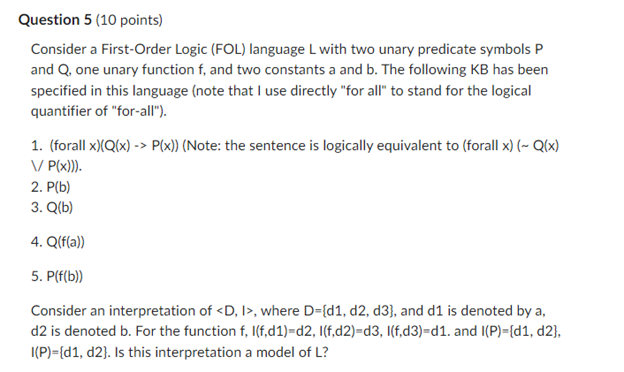
Consider a First-Order Logic (FOL) language L with two unary predicate symbols P and Q, one unary function f, and two constants a and b. The following KB has been specified in this language (note that I use directly "for all" to stand for the logical quantifier of "for-all"). 1. (forall x)(Q(x)>P(x)) (Note: the sentence is logically equivalent to (forall x)(Q(x) /P(x))) 2. P(b) 3. Q (b) 4. Q(f(a)) 5. P(f(b)) Consider an interpretation of
Step by Step Solution
There are 3 Steps involved in it
1 Expert Approved Answer
Step: 1 Unlock

Question Has Been Solved by an Expert!
Get step-by-step solutions from verified subject matter experts
Step: 2 Unlock
Step: 3 Unlock
 Study Help