







Question: Consider a function defined only on [0, L) with formula f(x) = 22. Even though the formula is well-defined outside that interval, we are not
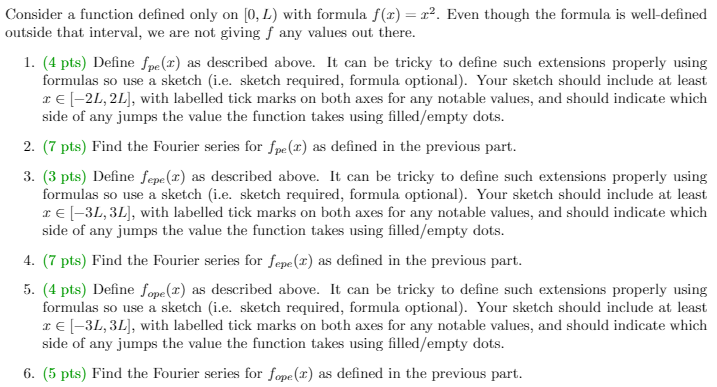
Consider a function defined only on [0, L) with formula f(x) = 22. Even though the formula is well-defined outside that interval, we are not giving f any values out there. 1. (4 pts) Define fpe (1) as described above. It can be tricky to define such extensions properly using formulas so use a sketch (i.e. sketch required, formula optional). Your sketch should include at least [-2., 21], with labelled tick marks on both axes for any notable values, and should indicate which side of any jumps the value the function takes using filled/empty dots. 2. (7 pts) Find the Fourier series for Spe(I) as defined in the previous part. 3. (3 pts) Define fepe (2) as described above. It can be tricky to define such extensions properly using formulas so use a sketch (i.e. sketch required, formula optional). Your sketch should include at least 1 [-3L, 3L], with labelled tick marks on both axes for any notable values, and should indicate which side of any jumps the value the function takes using filled/empty dots. 4. (7 pts) Find the Fourier series for fepe(x) as defined in the previous part. 5. (4 pts) Define fope (2) as described above. It can be tricky to define such extensions properly using formulas so use a sketch (i.e. sketch required, formula optional). Your sketch should include at least re[-3L, 3L], with labelled tick marks on both axes for any notable values, and should indicate which side of any jumps the value the function takes using filled/empty dots. 6. (5 pts) Find the Fourier series for fope(x) as defined in the previous part. Consider a function defined only on [0, L) with formula f(x) = 22. Even though the formula is well-defined outside that interval, we are not giving f any values out there. 1. (4 pts) Define fpe (1) as described above. It can be tricky to define such extensions properly using formulas so use a sketch (i.e. sketch required, formula optional). Your sketch should include at least [-2., 21], with labelled tick marks on both axes for any notable values, and should indicate which side of any jumps the value the function takes using filled/empty dots. 2. (7 pts) Find the Fourier series for Spe(I) as defined in the previous part. 3. (3 pts) Define fepe (2) as described above. It can be tricky to define such extensions properly using formulas so use a sketch (i.e. sketch required, formula optional). Your sketch should include at least 1 [-3L, 3L], with labelled tick marks on both axes for any notable values, and should indicate which side of any jumps the value the function takes using filled/empty dots. 4. (7 pts) Find the Fourier series for fepe(x) as defined in the previous part. 5. (4 pts) Define fope (2) as described above. It can be tricky to define such extensions properly using formulas so use a sketch (i.e. sketch required, formula optional). Your sketch should include at least re[-3L, 3L], with labelled tick marks on both axes for any notable values, and should indicate which side of any jumps the value the function takes using filled/empty dots. 6. (5 pts) Find the Fourier series for fope(x) as defined in the previous part
Step by Step Solution
There are 3 Steps involved in it

Get step-by-step solutions from verified subject matter experts
 Study Help