







Question: Consider a graph G = (V, E) with vertex set and edge set V = {(1, 22, 23) | 21, 22, 23 {0,1}} =
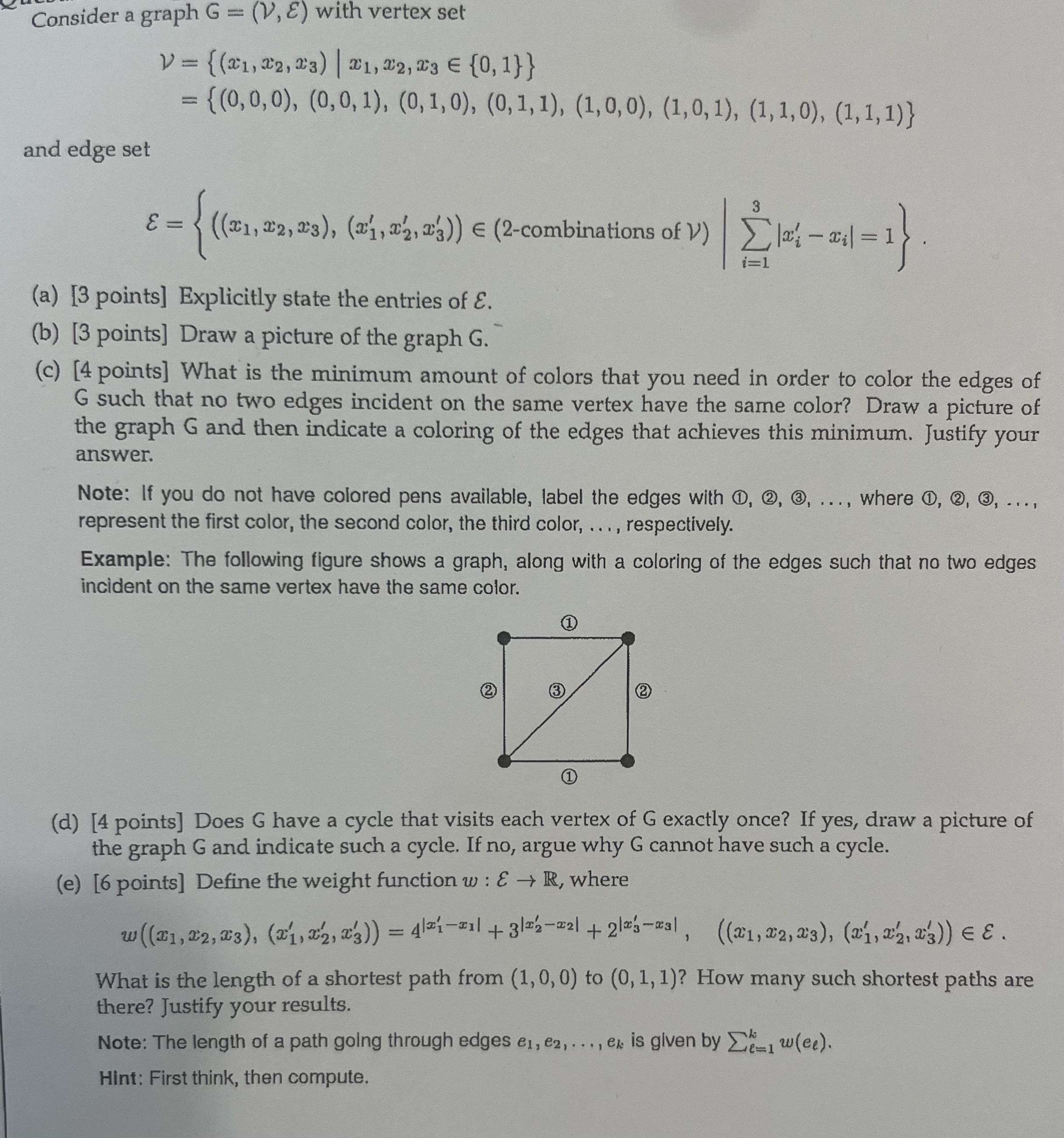
Consider a graph G = (V, E) with vertex set and edge set V = {(1, 22, 23) | 21, 22, 23 {0,1}} = {(0,0,0), (0,0,1), (0, 1, 0), (0, 1, 1), (1, 0, 0), (1, 0, 1), (1, 1,0), (1,1,1)} = {((231, 232,33), (2, 23, 24)) (2-combinations of V) - sil=1}. E E 3 (a) [3 points] Explicitly state the entries of E. (b) [3 points] Draw a picture of the graph G. (c) [4 points] What is the minimum amount of colors that you need in order to color the edges of G such that no two edges incident on the same vertex have the same color? Draw a picture of the graph G and then indicate a coloring of the edges that achieves this minimum. Justify your answer. i=1 Note: If you do not have colored pens available, label the edges with 0, 2, 3, ..., where 0, 2, 3, ..., represent the first color, the second color, the third color, ..., respectively. (1) Example: The following figure shows a graph, along with a coloring of the edges such that no two edges incident on the same vertex have the same color. 3 (1 (d) [4 points] Does G have a cycle that visits each vertex of G exactly once? If yes, draw a picture of the graph G and indicate such a cycle. If no, argue why G cannot have such a cycle. (e) [6 points] Define the weight function w: E R, where w ((#, #2, #3), (X' X'2, x'3)) = 41-1| +3|2-721 +23-), ((#1, #2, 23), (X', T2, T3)) & . What is the length of a shortest path from (1,0,0) to (0, 1, 1)? How many such shortest paths are there? Justify your results. Note: The length of a path going through edges e1,e2, ..., ek is given by e=1 w(ee). Hint: First think, then compute. Consider a graph G = (V, E) with vertex set and edge set V = {(1, 22, 23) | 21, 22, 23 {0,1}} = {(0,0,0), (0,0,1), (0, 1, 0), (0, 1, 1), (1,0,0), (1,0, 1), (1, 1,0), (1,1,1)} = {((231, 232,33), (2, 23, 24)) (2-combinations of V) - sil=1}. E E 3 (a) [3 points] Explicitly state the entries of E. (b) [3 points] Draw a picture of the graph G. (c) [4 points] What is the minimum amount of colors that you need in order to color the edges of G such that no two edges incident on the same vertex have the same color? Draw a picture of the graph G and then indicate a coloring of the edges that achieves this minimum. Justify your answer. i=1 Note: If you do not have colored pens available, label the edges with 0, 2, 3, ..., where 0, 2, 3, ..., represent the first color, the second color, the third color, ..., respectively. (1) Example: The following figure shows a graph, along with a coloring of the edges such that no two edges incident on the same vertex have the same color. 3 (1 (d) [4 points] Does G have a cycle that visits each vertex of G exactly once? If yes, draw a picture of the graph G and indicate such a cycle. If no, argue why G cannot have such a cycle. (e) [6 points] Define the weight function w: E R, where w ((#, #2, #3), (X' X'2, x'3)) = 41-1| +3|2-721 +23-), ((#1, #2, 23), (X', T2, T3)) & . What is the length of a shortest path from (1,0,0) to (0, 1, 1)? How many such shortest paths are there? Justify your results. Note: The length of a path going through edges e1,e2, ..., ek is given by e=1 w(ee). Hint: First think, then compute. Consider a graph G = (V, E) with vertex set and edge set V = {(1, 22, 23) | 21, 22, 23 {0,1}} = {(0,0,0), (0,0,1), (0, 1, 0), (0, 1, 1), (1, 0, 0), (1, 0, 1), (1, 1,0), (1,1,1)} = {((231, 232,33), (2, 23, 24)) (2-combinations of V) - sil=1}. E E 3 (a) [3 points] Explicitly state the entries of E. (b) [3 points] Draw a picture of the graph G. (c) [4 points] What is the minimum amount of colors that you need in order to color the edges of G such that no two edges incident on the same vertex have the same color? Draw a picture of the graph G and then indicate a coloring of the edges that achieves this minimum. Justify your answer. i=1 Note: If you do not have colored pens available, label the edges with 0, 2, 3, ..., where 0, 2, 3, ..., represent the first color, the second color, the third color, ..., respectively. (1) Example: The following figure shows a graph, along with a coloring of the edges such that no two edges incident on the same vertex have the same color. 3 (1 (d) [4 points] Does G have a cycle that visits each vertex of G exactly once? If yes, draw a picture of the graph G and indicate such a cycle. If no, argue why G cannot have such a cycle. (e) [6 points] Define the weight function w: E R, where w ((#, #2, #3), (X' X'2, x'3)) = 41-1| +3|2-721 +23-), ((#1, #2, 23), (X', T2, T3)) & . What is the length of a shortest path from (1,0,0) to (0, 1, 1)? How many such shortest paths are there? Justify your results. Note: The length of a path going through edges e1,e2, ..., ek is given by e=1 w(ee). Hint: First think, then compute.
Step by Step Solution
3.40 Rating (163 Votes )
There are 3 Steps involved in it
a The edge set E consists of a single edge connecting vertices x1 x2 x3 and x1 x2 x3 where x1 x2 x3 ... View full answer

Get step-by-step solutions from verified subject matter experts
 Study Help