







Question: Consider a hypothetical computer which supports a ternary (or base-3) number system. In representation, the digits used to form a base-3 number are only 0,1
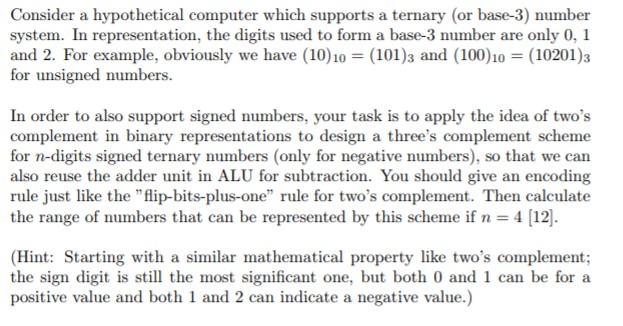
Consider a hypothetical computer which supports a ternary (or base-3) number system. In representation, the digits used to form a base-3 number are only 0,1 and 2. For example, obviously we have (10) 10 = (101)3 and (100)10 = (10201)3 for unsigned numbers. In order to also support signed numbers, your task is to apply the idea of two's complement in binary representations to design a three's complement scheme for n-digits signed ternary numbers (only for negative numbers), so that we carn also reuse the adder unit in ALU for subtraction. You should give an encoding rule just like the "flip-bits-plus-one" rule for two's complement. Then calculate the range of numbers that can be represented by this scheme if n 4 12 (Hint: Starting with a similar mathematical property like two's complement the sign digit is still the most significant one, but both 0 and 1 can be fora positive value and both 1 and 2 can indicate a negative value.)
Step by Step Solution
There are 3 Steps involved in it

Get step-by-step solutions from verified subject matter experts
 Study Help