







Question: Consider a k-bit hash function H(x) (i.e., it outputs k-bit hash values). It is preimage resistant and collision resistant. Now construct a (k+1)-bit hash function
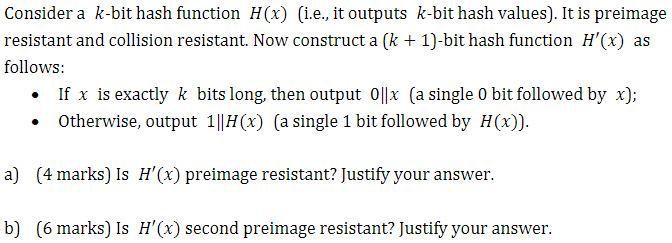
Consider a k-bit hash function H(x) (i.e., it outputs k-bit hash values). It is preimage resistant and collision resistant. Now construct a (k+1)-bit hash function H(x) as follows: - If x is exactly k bits long, then output 0x (a single 0 bit followed by x ); - Otherwise, output 1H(x) (a single 1 bit followed by H(x) ). a) (4 marks) Is H(x) preimage resistant? Justify your answer. b) ( 6 marks) Is H(x) second preimage resistant? Justify your
Step by Step Solution
There are 3 Steps involved in it
1 Expert Approved Answer
Step: 1 Unlock

Question Has Been Solved by an Expert!
Get step-by-step solutions from verified subject matter experts
Step: 2 Unlock
Step: 3 Unlock
 Study Help