







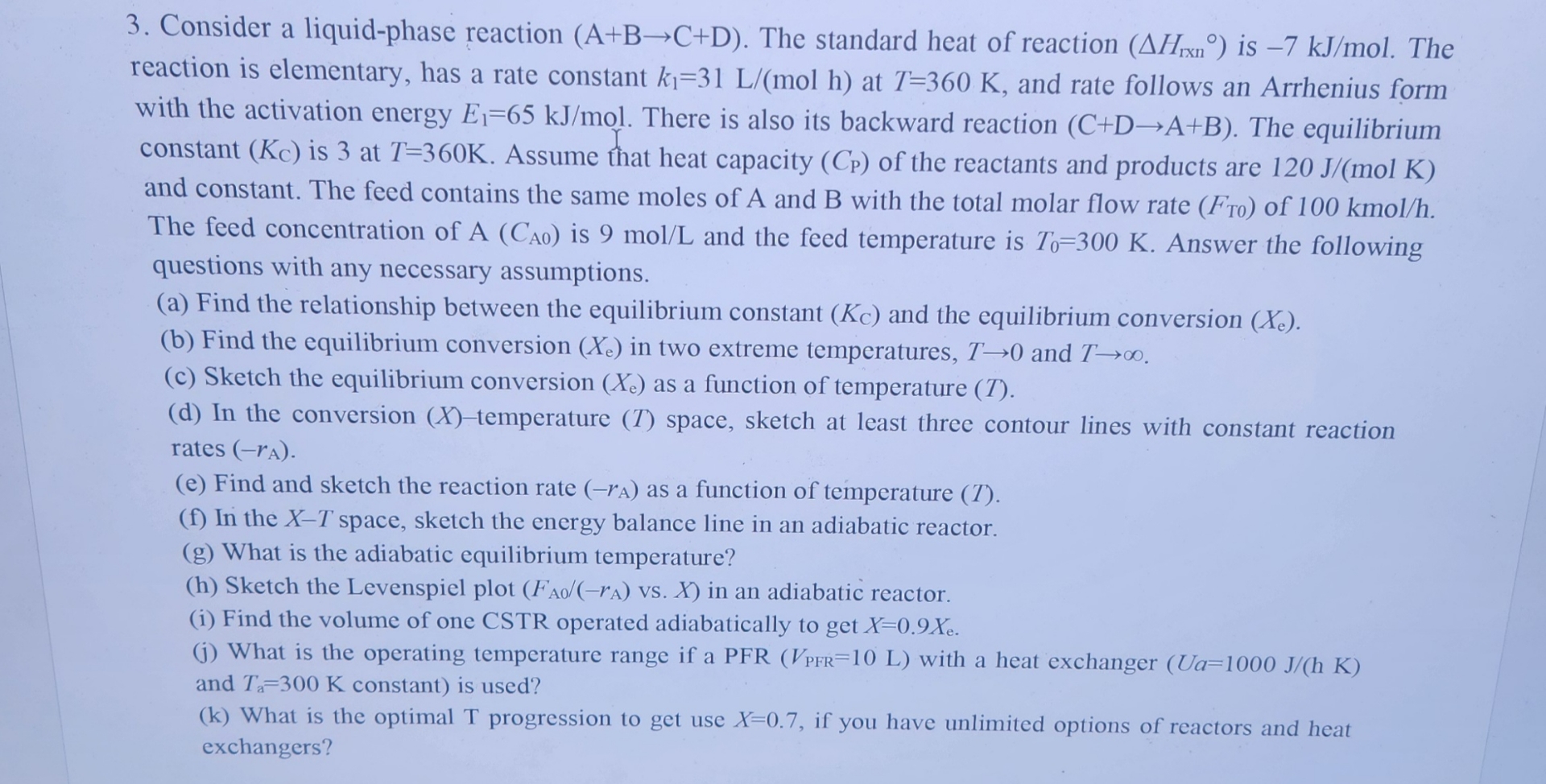
Question: Consider a liquid - phase reaction ( A + B C + D ) . The standard heat of reaction ( H r x n
Consider a liquidphase reaction The standard heat of reaction is The reaction is elementary, has a rate constant at and rate follows an Arrhenius form with the activation energy There is also its backward reaction The equilibrium constant is at Assume that heat capacity of the reactants and products are and constant. The feed contains the same moles of A and with the total molar flow rate of kmo The feed concentration of is and the feed temperature is Answer the following questions with any necessary assumptions.
a Find the relationship between the equilibrium constant and the equilibrium conversion
b Find the equilibrium conversion in two extreme temperatures, and
c Sketch the equilibrium conversion as a function of temperature T
d In the conversion temperature space, sketch at least three contour lines with constant reaction rates
e Find and sketch the reaction rate as a function of temperature
f In the space, sketch the energy balance line in an adiabatic reactor.
g What is the adiabatic equilibrium temperature?
h Sketch the Levenspiel plot vs: in an adiabatic reactor.
i Find the volume of one CSTR operated adiabatically to get
j What is the operating temperature range if a PFR with a heat exchanger and constant is used?
k What is the optimal progression to get use if you have unlimited options of reactors and heat exchangers?
Step by Step Solution
There are 3 Steps involved in it
1 Expert Approved Answer
Step: 1 Unlock

Question Has Been Solved by an Expert!
Get step-by-step solutions from verified subject matter experts
Step: 2 Unlock
Step: 3 Unlock
 Study Help