







Question: Consider a market where aggregate demand is given by Q=I GilP There is a monopoly rm in the market with costs of production C(Q}=5GQ+EGQ (a)
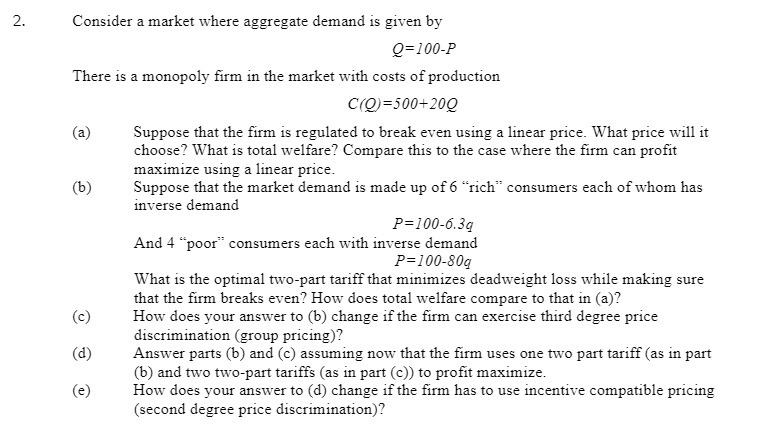
Consider a market where aggregate demand is given by Q=I GilP There is a monopoly rm in the market with costs of production C(Q}=5GQ+EGQ (a) Suppose that the firm is regulated to break even using a linear price. What price will it choose?I What is total welfare? Compare this to the case where the rm can prot maximize using a linear price. (b) Suppose that the market demand is made up of 6 \"rich\" consumers each of whom has inverse demand P =1 00 :5. 3:; And 4 \"poor" consumers each with inverse demand P =1 Sq What is the optimal twopart tariff that minimizes deadweight loss while making sure that the rm breaks even? How does total welfare compare to that in (a)? (c) How does your answer to {b} change if the rm can exercise third degree price discrimination (group pricing)? (d) Answer parts {b} and (c) assuming now that the rm uses one two part tariff (as in part {b} and two twopart taris (as in part (c)} to prot maximize- (e) How does your answer to ([1) change if the rm has to use incentive compatible pricing {second degree price discrimination)
Step by Step Solution
There are 3 Steps involved in it

Get step-by-step solutions from verified subject matter experts
 Study Help