







Question: . Consider a market with an inverse demand function, P (Q) = 60 5Q. There are two possible suppliers in the market, rms A and
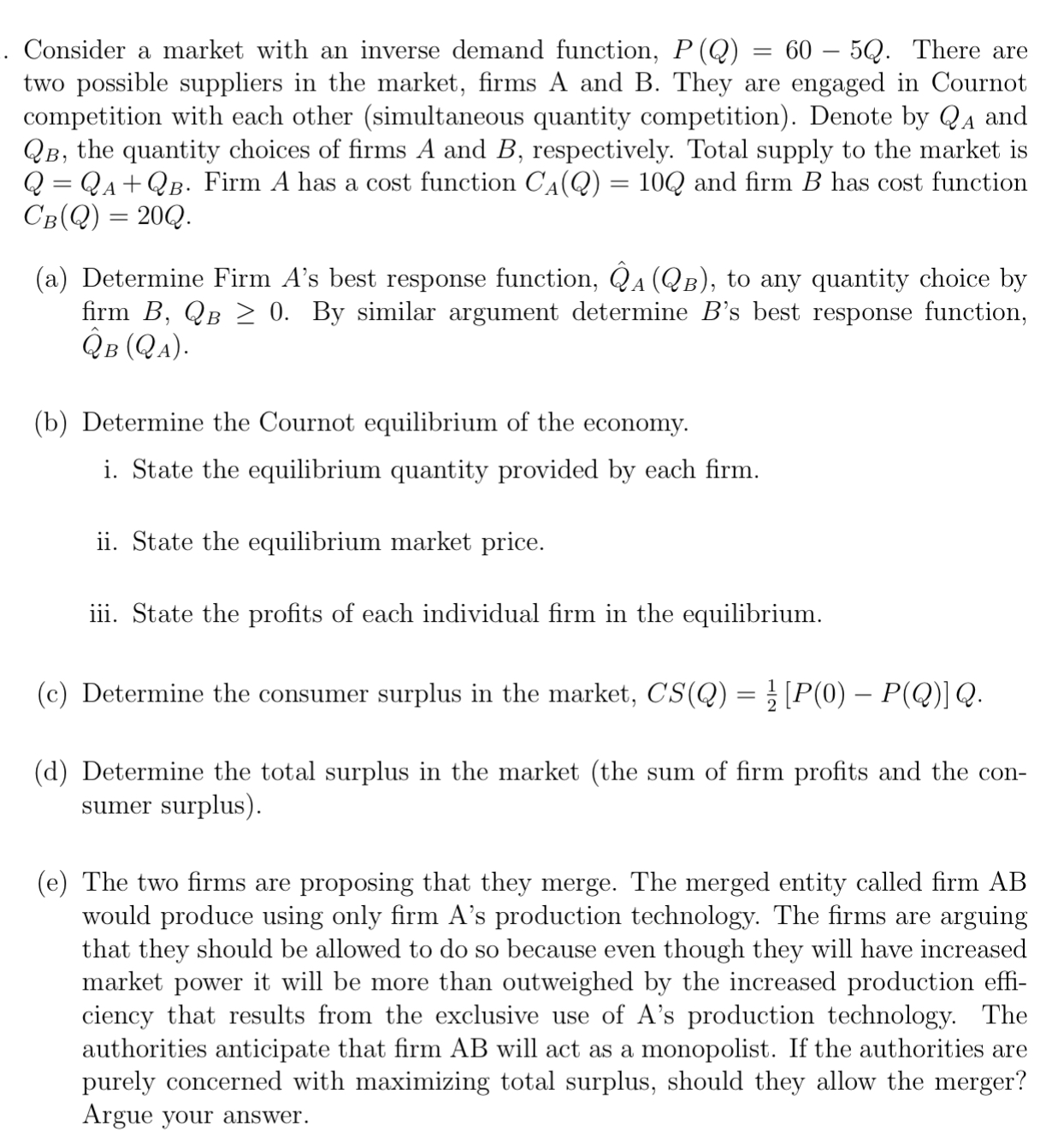
. Consider a market with an inverse demand function, P (Q) = 60 5Q. There are two possible suppliers in the market, rms A and B. They are engaged in Cournot competition with each other (simultaneous quantity competition). Denote by Q A and Q3, the quantity choices of rms A and B, respectively. Total supply to the market is Q 2 QA -+- QB. Firm A has a cost function CA(Q) = 1062 and rm B has cost function Cle) = 20Q- (a) Determine Firm A's best response function, QA (QB), to any quantity choice by rm B, Q3 2 D. By similar argument determine B's best response function, QB (QAl- (b) Determine. the Cournot equilibrium of the economy. i. State the equilibrium quantity provided by each rm. ii. State the equilibrium market price. iii. State the prots of each individual rm in the equilibrium. (c) Determine the consumer surplus in the market, CS(Q) = % [P(0) P(Q)] Q. (d) Determine the total surplus in the market (the sum of rm prots and the con sumer surplus). (e) The two rms are proposing that they merge. The merged entity called rm AB would produce using only rm A's production technology. The rms are arguing that they should be allowed to do so because even though they will have increased market power it will be more than outweighed by the increased production ef ciency that results from the exclusive use of A's production technology. The authorities anticipate that rm AB will act as a monopolist. If the authorities are purely concerned with maximizing total surplus, should they allow the merger? Argue your
Step by Step Solution
There are 3 Steps involved in it

Get step-by-step solutions from verified subject matter experts
 Study Help