



Question: Consider a network of one server and N = 3 peers, given that (1) ug = 2, u = 3, U2 = 2, and u3
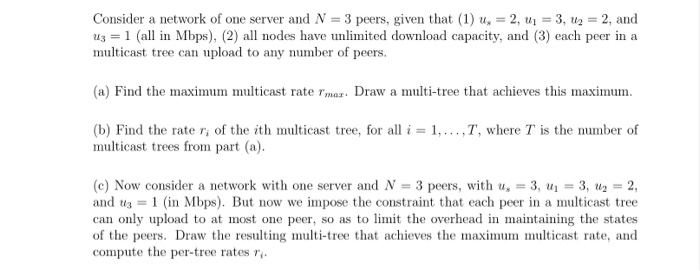
Consider a network of one server and N = 3 peers, given that (1) ug = 2, u = 3, U2 = 2, and u3 = 1 (all in Mbps), (2) all nodes have unlimited download capacity, and (3) each peer in a multicast tree can upload to any number of peers. (a) Find the maximum multicast rate mor. Draw a multi-tree that achieves this maximum. (b) Find the rate r; of the ith multicast tree, for all i = 1,...,T, where T is the number of multicast trees from part (a). (C) Now consider a network with one server and N = 3 peers, with ug = 3, u = 3, uy = 2, and uz = 1 (in Mbps). But now we impose the constraint that each peer in a multicast tree can only upload to at most one peer, so as to limit the overhead in maintaining the states of the peers. Draw the resulting multi-tree that achieves the maximum multicast rate, and compute the per-tree rates 7. Consider a network of one server and N = 3 peers, given that (1) ug = 2, u = 3, U2 = 2, and u3 = 1 (all in Mbps), (2) all nodes have unlimited download capacity, and (3) each peer in a multicast tree can upload to any number of peers. (a) Find the maximum multicast rate mor. Draw a multi-tree that achieves this maximum. (b) Find the rate r; of the ith multicast tree, for all i = 1,...,T, where T is the number of multicast trees from part (a). (C) Now consider a network with one server and N = 3 peers, with ug = 3, u = 3, uy = 2, and uz = 1 (in Mbps). But now we impose the constraint that each peer in a multicast tree can only upload to at most one peer, so as to limit the overhead in maintaining the states of the peers. Draw the resulting multi-tree that achieves the maximum multicast rate, and compute the per-tree rates 7
Step by Step Solution
There are 3 Steps involved in it

Get step-by-step solutions from verified subject matter experts