







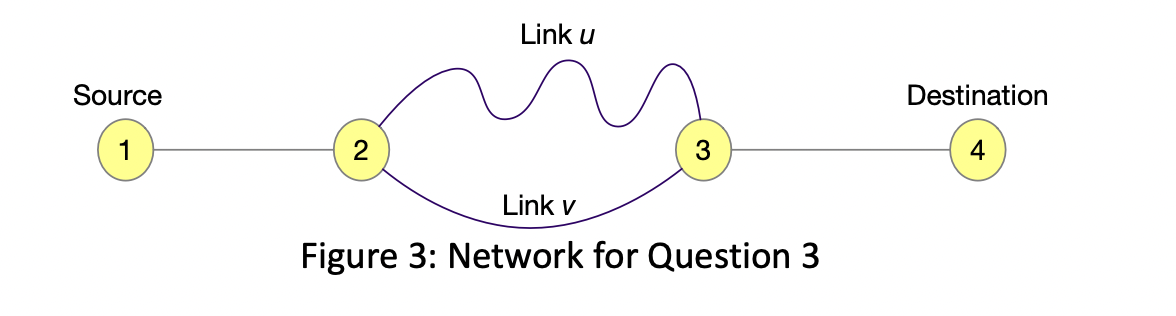
Question: Consider a network with 3 hops shown in Figure 3 . Packets at node 2 sent toward node 3 ( or vice versa ) will
Consider a network with hops shown in Figure Packets at node sent toward node or vice versa will take link u with probability and link v with probability Retransmissions take the same path as the original packet. The propagation delays on links u v are msmsms and ms respectively. Assume that propagation delay dominates.
a What is the longterm average RTT observed by the sender transmitting TCP segments to the destination? Explain your calculations clearly.
b If a stopandwait transport layer protocol is used, and a GB file, broken into byte segments is sent, how much time in hours would it take for the file to be received at the destination if there are no lost packets and no errors? Ignore lower layer effects. Assume of the packets take link u and take link v
c Next consider layering ignored in b Let Ethernet frames be transmitted on each link and are bytes long.. They carry the IP datagram and TCP segments. TCP adds bits as header for each Layer segment. Each TCP segment is carried by an IP datagram with a bit header. The IP datagrams form the payload of Ethernet, which has a bit header and a bit CRC How many bits of data are sent on the physical medium to complete the transmission of all of the application data the GB file And how long in hours would it take to deliver the GB file to the destination? Again, assume of the packets take link u and take link v Comment on howwhy this result is different from that in Qb
d Explain in six or fewer sentences how a GoBackN or Selective Repeat protocol helps reduce the time taken to deliver the file use an example data rate of Mbps on all links
Step by Step Solution
There are 3 Steps involved in it
1 Expert Approved Answer
Step: 1 Unlock

Question Has Been Solved by an Expert!
Get step-by-step solutions from verified subject matter experts
Step: 2 Unlock
Step: 3 Unlock
 Study Help