





Question: Consider a parallel plate capacitor, in which the gap is 2d and the radius is much larger. Suppose that the upper and lower plates are
 Consider a parallel plate capacitor, in which the gap is 2d

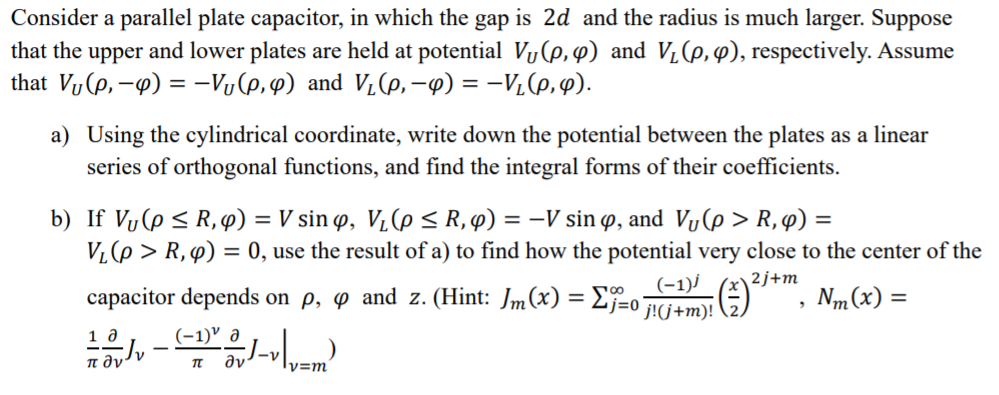
Consider a parallel plate capacitor, in which the gap is 2d and the radius is much larger. Suppose that the upper and lower plates are held at potential Vu(0,0) and V_(0,0), respectively. Assume that Vy(,-0) = -Vy(0,0) and V_(0,-Q) = -V,(0,0). a) Using the cylindrical coordinate, write down the potential between the plates as a linear series of orthogonal functions, and find the integral forms of their coefficients. b) If Vulp SR,Q) = V sin q, V. (p R,0) = V. (p > R,0) = 0, use the result of a) to find how the potential very close to the center of the (-1) 2j+m capacitor depends on P, Q and z. (Hint: Im(x) = {j=0 Nm(x) = j!(j+m)! (-1)' a houdy * OvJcvyam TT Consider a parallel plate capacitor, in which the gap is 2d and the radius is much larger. Suppose that the upper and lower plates are held at potential Vu(0,0) and V_(0,0), respectively. Assume that Vy(,-0) = -Vy(0,0) and V_(0,-Q) = -V,(0,0). a) Using the cylindrical coordinate, write down the potential between the plates as a linear series of orthogonal functions, and find the integral forms of their coefficients. b) If Vulp SR,Q) = V sin q, V. (p R,0) = V. (p > R,0) = 0, use the result of a) to find how the potential very close to the center of the (-1) 2j+m capacitor depends on P, Q and z. (Hint: Im(x) = {j=0 Nm(x) = j!(j+m)! (-1)' a houdy * OvJcvyam TT

Step by Step Solution

There are 3 Steps involved in it

1 Expert Approved Answer
Step: 1 Unlock blur-text-image
Question Has Been Solved by an Expert!

Get step-by-step solutions from verified subject matter experts

Step: 2 Unlock
Step: 3 Unlock

Students Have Also Explored These Related Accounting Questions!