







Question: Consider a partial equilibrium neoclassical investment framework with an all equity financed firm. assume perfect competition (in both goods and labor markets), no manager-shareholder conflicts,
Consider a partial equilibrium neoclassical investment framework with an all equity financed firm. assume perfect competition (in both goods and labor markets), no manager-shareholder conflicts, and that firm maximizes shareholder value. assume a constant and positive discount rate, Mt1 P r0, 1q that is given exogenously (e.g., risk-neutral investors). the firm has access to cobb-douglas production technology that uses physical capital Kt and labor Lt as inputs:

the source of funds constraint:

where  ~ Dividends,
  ~ Operating Profits,
  ~ Investment, and
  ~ capital adjustment costs. Assuming quadratic adjustment costs:

where  > 0. the firm accumulates capital according to the law of motion:

t where > 0 is the depreciation rate. The firms problem is summarized by the following program:
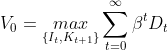
subject to


Part a: Are the hayashi conditions satisfied? derive the operating profits as a function of production capacity and productivity (i.e., substitute out the labor input).
Part b:
rewrite the firms problem recursively and derive the firms first-order and envelope conditions. what is the return on investment? does the return on investment coincide with the stock return? provide a proof either way.
Y = AKL- - D= Tt-17 - 0(It, Kt) 14 - 1. D (1,K) t t 0(1+, K+) = 1/2*K*(1+/K+)? * K Kt+1 = (1 - 8) K +17 + V% = = max 'D, {IA,K+1} t= =O Y = AKL- - D= Tt-17 - 0(It, Kt) 14 - 1. D (1,K) t t 0(1+, K+) = 1/2*K*(1+/K+)? * K Kt+1 = (1 - 8) K +17 + V% = = max 'D, {IA,K+1} t= =O
Step by Step Solution
There are 3 Steps involved in it

Get step-by-step solutions from verified subject matter experts
 Study Help