







Question: Consider a perfect competitive firm has the production function: q(L,K) = Lakb where a and b are the output elasticities of labor and capital, respectively.
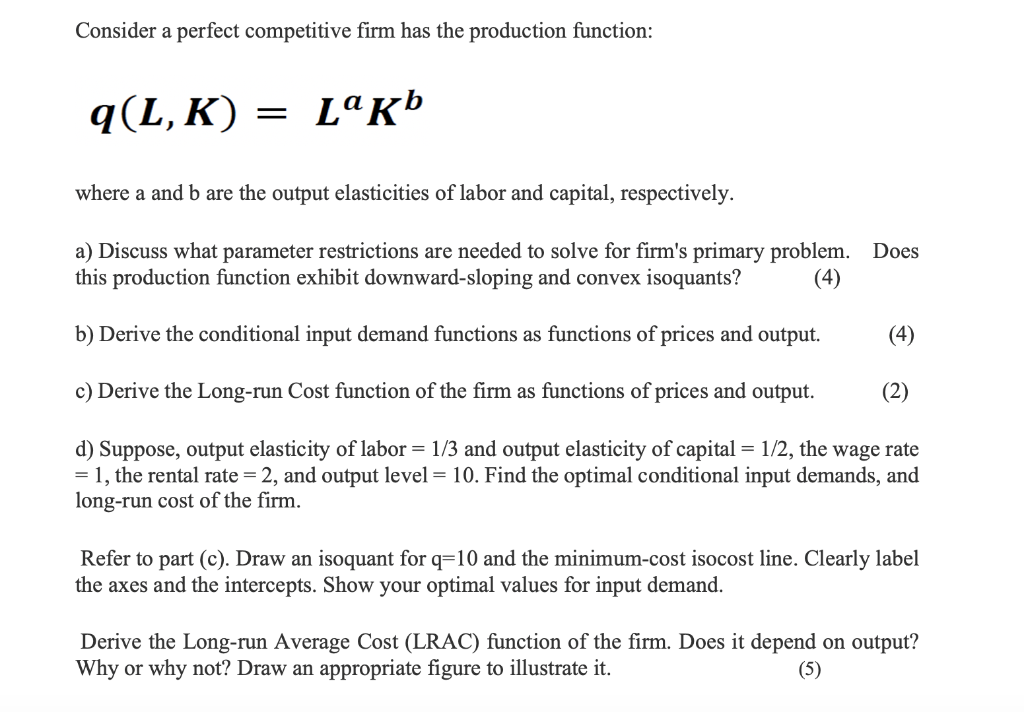
Consider a perfect competitive firm has the production function: q(L,K) = Lakb where a and b are the output elasticities of labor and capital, respectively. a) Discuss what parameter restrictions are needed to solve for firm's primary problem. Does this production function exhibit downward-sloping and convex isoquants? (4) b) Derive the conditional input demand functions as functions of prices and output. (4) c) Derive the Long-run Cost function of the firm as functions of prices and output. (2) d) Suppose, output elasticity of labor = 1/3 and output elasticity of capital = 1/2, the wage rate = 1, the rental rate = 2, and output level = 10. Find the optimal conditional input demands, and long-run cost of the firm. Refer to part (c). Draw an isoquant for q=10 and the minimum-cost isocost line. Clearly label the axes and the intercepts. Show your optimal values for input demand. Derive the Long-run Average Cost (LRAC) function of the firm. Does it depend on output? Why or why not? Draw an appropriate figure to illustrate it
Step by Step Solution
There are 3 Steps involved in it

Get step-by-step solutions from verified subject matter experts
 Study Help