







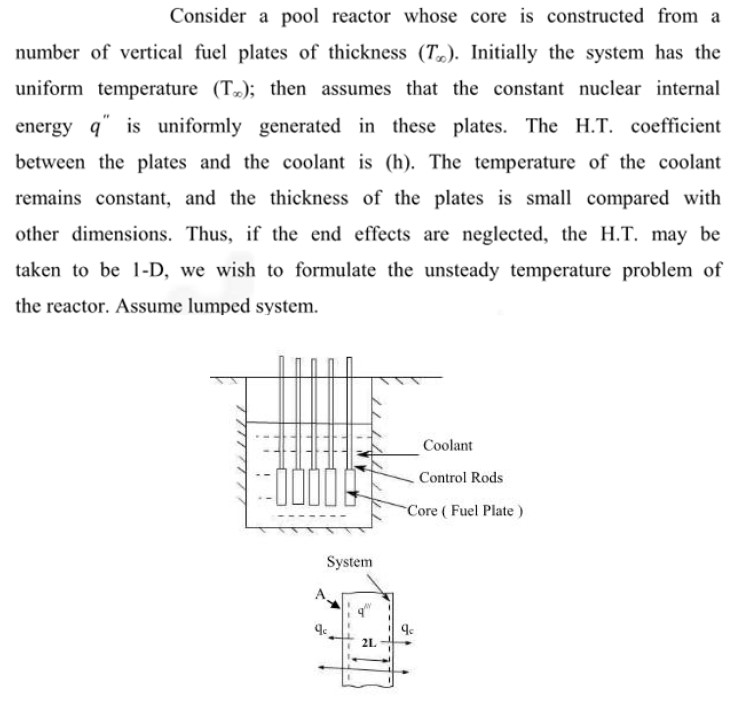
Question: Consider a pool reactor whose core is constructed from a number of vertical fuel plates of thickness T . Initially the system has the uniform
Consider a pool reactor whose core is constructed from a number of vertical fuel plates of thickness T Initially the system has the uniform temperature T; then assume that the constant nuclear internal energy q is uniformly generated in these plates. The heat transfer coefficient between the plates and the coolant is h The temperature of the coolant remains constant, and the thickness of the plates is small compared with other dimensions. Thus, if the end effects are neglected, the heat transfer may be taken to be onedimensional. We wish to formulate the unsteady temperature problem of the reactor. Assume lumped system. Consider a pool reactor whose core is constructed from a number of vertical fuel plates of thickness leftTinftyright Initially the system has the uniform temperature leftmathrmTinftyright; then assumes that the constant nuclear internal energy qprime prime is uniformly generated in these plates. The HT coefficient between the plates and the coolant is h The temperature of the coolant remains constant, and the thickness of the plates is small compared with other dimensions. Thus, if the end effects are neglected, the HT may be taken to be D we wish to formulate the unsteady temperature problem of the reactor. Assume lumped system.
Step by Step Solution
There are 3 Steps involved in it
1 Expert Approved Answer
Step: 1 Unlock

Question Has Been Solved by an Expert!
Get step-by-step solutions from verified subject matter experts
Step: 2 Unlock
Step: 3 Unlock
 Study Help