







Question: Consider a rectangular slab system for an office building in the figure, which is supported by 4 0 0 mm wide and 6 0 0
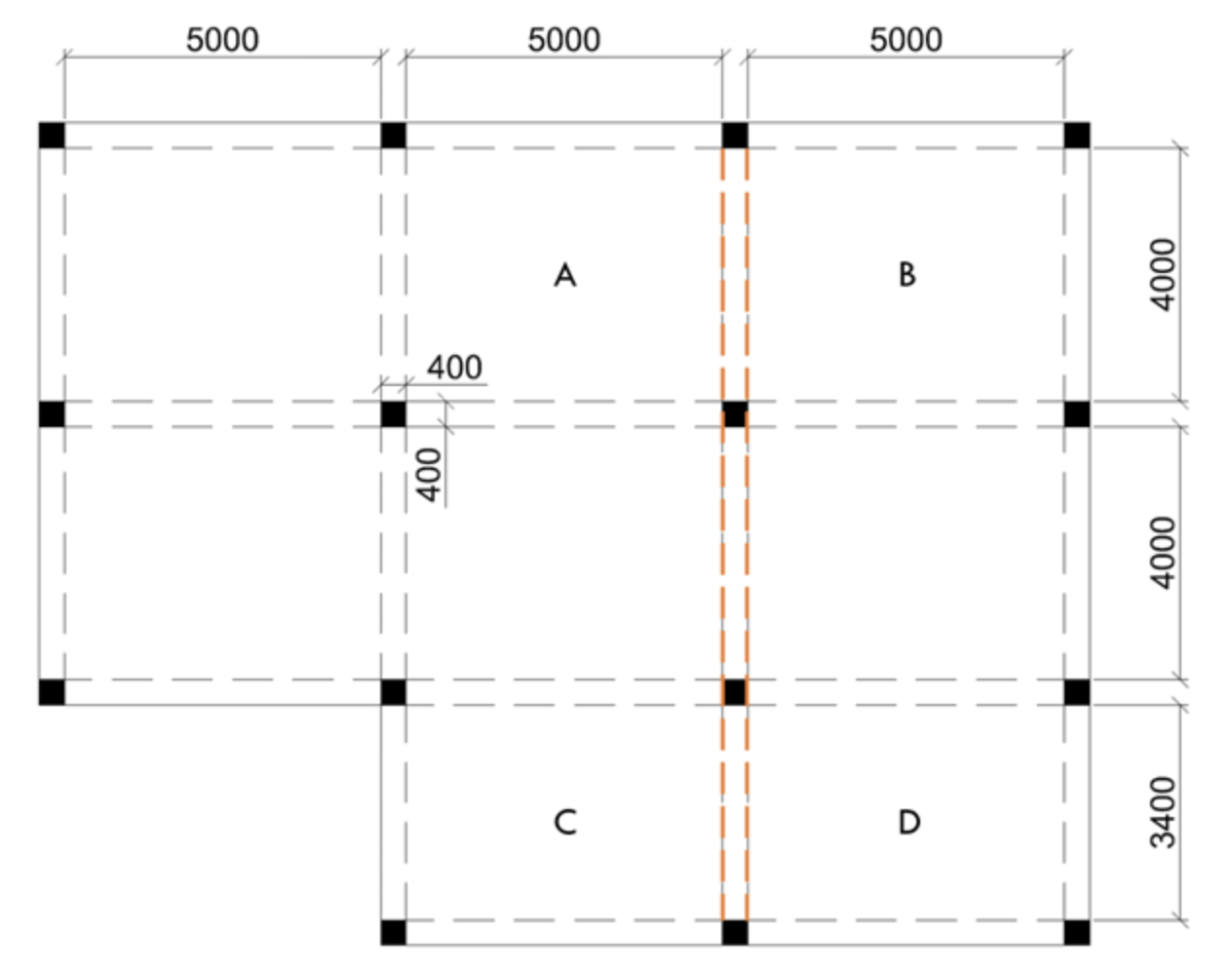
Consider a rectangular slab system for an office building in the figure, which is supported by mm wide and mm deep beams. The office is located in Meckering, WA The concrete has a characteristic strength of MPa in all members. N D reinforcement bars are to be used in all slabs, and N D reinforcement bars in all beams. The live load is kPa, and the suspended ceilings represent a kPa permanent loading. The permanent load equivalent to partition walls and tiles can be considered as a superimposed dead load on the whole surface of the slabs of kPa. The density of reinforced concrete is kNm
REFER TO SLAB PANEL C for the following questions
Question
a Calculate the minimum cover and thickness to satisfy durability and fire requirements according to Australian Standards. Note: the design Fire Resistance Levels to satisfy the BCA are
b Determine the combination factors for shortterm and longterm loading effects, as well as the loading for ultimate limit states, in accordance with AS
Note: In the following questions, consider the minimum cover is mm and Psi s and Psi l whenever needed.
c Work out the minimum thickness for the selected slab panel using the deemedtocomply approach in AS
Note: In the following questions, assume the slab thickness is mm
d Calculate the minimum longitudinal reinforcement required for the slab.
e Design the amount of longitudinal reinforcement in both directions and check for the ultimate limit state of flexure.
f Finalise the layout of reinforcements based on the deemedtocomply approach in AS Sketch the details of the reinforcements in the plan and elevation.
Question
a Based on the tributary areas, work out the load transferred from the slabs to the beam marked by orange dashed lines please refer to Fig.
b For the same beam, obtain an equivalent uniformly distributed load and develop a preliminary design for the layout of reinforcements for the crosssection located over the interior support.
Question
Can you explain the load path developed in a flat slab and the need to design the slab to carry the full amount of applied load in each direction? Why is the same consideration not needed in a twoway slab?
Step by Step Solution
There are 3 Steps involved in it
1 Expert Approved Answer
Step: 1 Unlock

Question Has Been Solved by an Expert!
Get step-by-step solutions from verified subject matter experts
Step: 2 Unlock
Step: 3 Unlock
 Study Help