







Question: Consider a recursive function de cToBin (decimal) that converts a decimal number to a binary representation but still in base 10 . Note that all
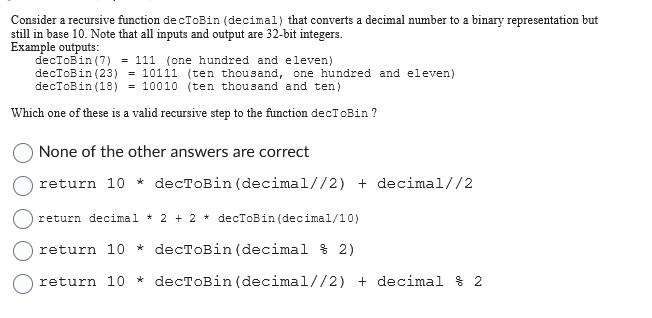
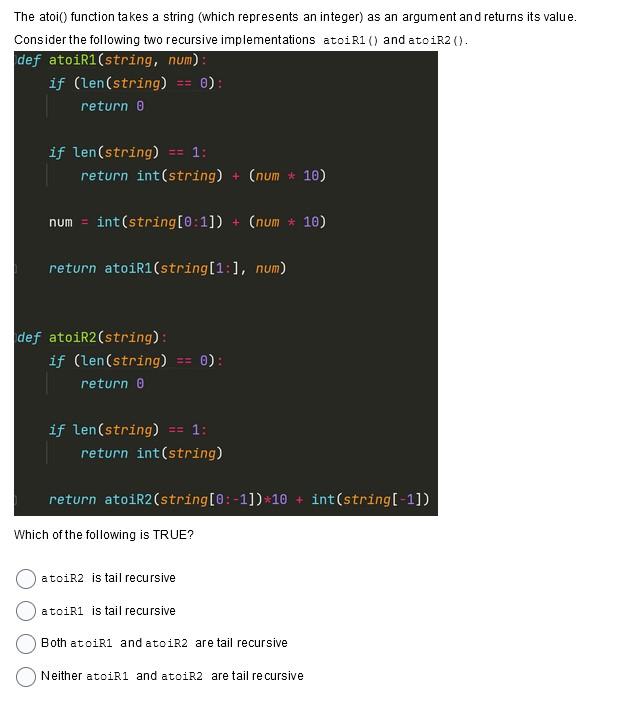
Consider a recursive function de cToBin (decimal) that converts a decimal number to a binary representation but still in base 10 . Note that all inputs and output are 32 -bit integers. Example outputs: decToBin (7)=111 (one hundred and eleven) decToBin (23)=10111 (ten thousand, one hundred and eleven) decToBin (18)=10010 (ten thousand and ten) Which one of these is a valid recursive step to the function decT oBin? None of the other answers are correct return 10 decToBin (decimal//2) + decimal//2 return decimal * 2+2decToBin(decima1/10) return 10decToBin(decimal2 ) return 10 * decToBin(decimal//2) + decimal o 2 The atoi() function takes a string (which represents an integer) as an argument and returns its value. Consider the following two recursive implementations atoiR1 () and atoiR2 }. def atoiR1 (string, num): Which of the following is TRUE? atoiR2 is tail recursive atoiR1 is tail recursive Both atoiR1 and atoiR2 are tail recursive Neither atoiR1 and atoiR2 are tail re cursive
Step by Step Solution
There are 3 Steps involved in it

Get step-by-step solutions from verified subject matter experts
 Study Help