







Question: Consider a relation R(A, B, C, D, E). Assume R satisfies the following functional dependencies: C E and A-C. Suppose we decompose R into these
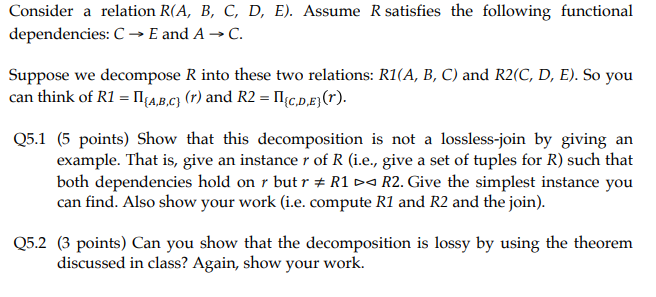
Consider a relation R(A, B, C, D, E). Assume R satisfies the following functional dependencies: C E and A-C. Suppose we decompose R into these two relations: R1(A, B, C) and R2(C, D, E). So you can think of R1-(A,B,C) (r) and R2-(C,D,E(r). Q5.1 (5 points) Show that this decomposition is not a lossless-join by giving an example. That is, give an instance r of R (i.e., give a set of tuples for R) such that both dependencies hold on r but r R1 cod R2. Give the simplest instance you can find. Also show your work (i.e. compute R1 and R2 and the join). Q5.2 (3 points) Can you show that the decomposition is lossy by using the theorenm discussed in class? Again, show your work
Step by Step Solution
There are 3 Steps involved in it

Get step-by-step solutions from verified subject matter experts
 Study Help