







Question: Consider a relation schema R = (A, B, C, D, E) and a set F consisting of the following functional dependencies that hold on R:
Consider a relation schema R = (A, B, C, D, E) and a set F consisting of the following functional dependencies that hold on R:
A -> C, AC -> E, AD -> B, B -> ADE, D-> E.
An algorithm for computing a lossless-join, dependency-preserving decomposition of a relation schema (using a canonical cover of a set of functional dependencies that hold on the schema) into a set of third normal form (3NF) relation schemas is given in the figure below. Use this algorithm to decompose R using Fc .
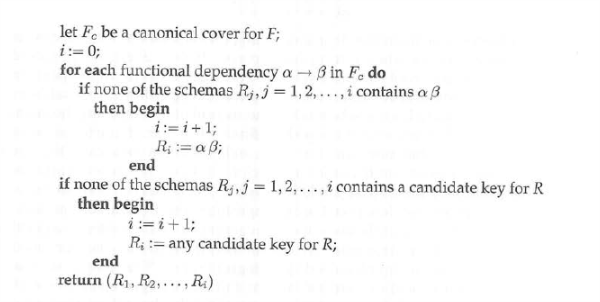
let Fe be a canonical cover for F; i: 0 for each functional dependency a in Fo do if none of the schemas Rj,j = 1, 2, . . . , i contains ?? then begin end if none of the schemas R, 1,2,,i contains a candidate key for R then begin Ri any candidate key for R; end return (R1, R2,.. ,R)
Step by Step Solution
There are 3 Steps involved in it

Get step-by-step solutions from verified subject matter experts
 Study Help