







Question: Consider a repeated game between a principal and an agent. In each period t=0,1,, the agent chooses how much effort e{eL,eH} to put. The cost
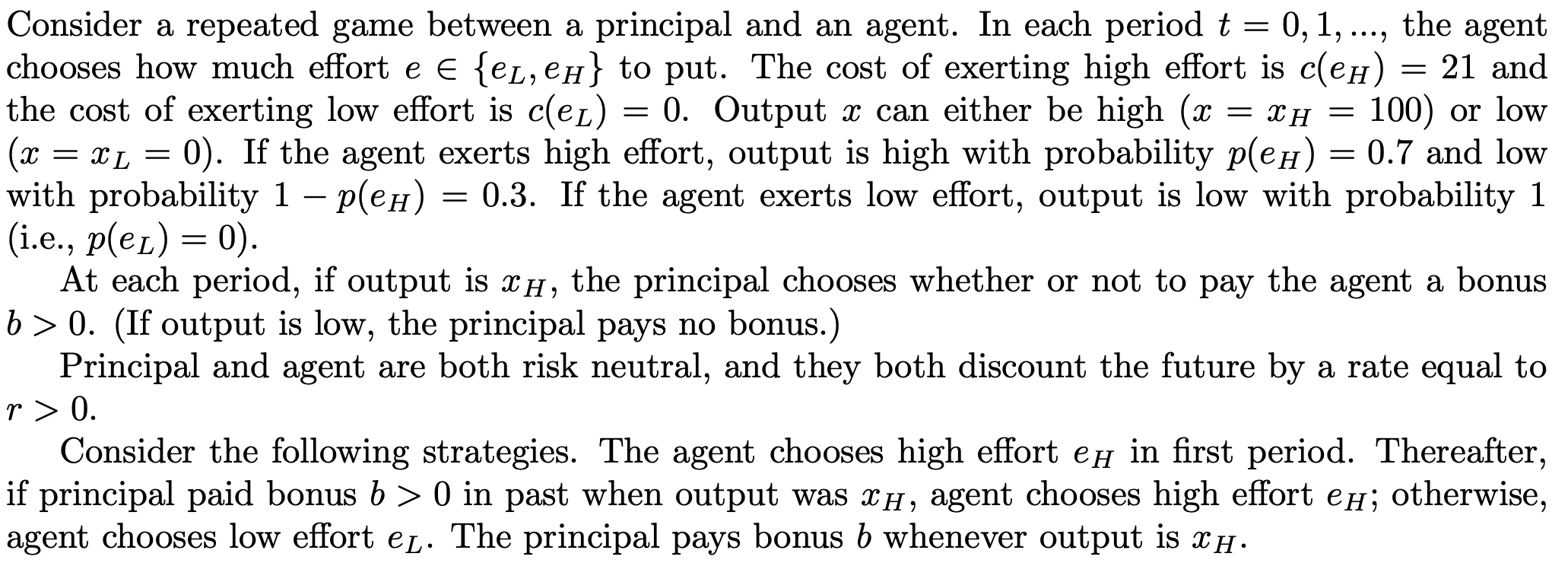

Consider a repeated game between a principal and an agent. In each period t=0,1,, the agent chooses how much effort e{eL,eH} to put. The cost of exerting high effort is c(eH)=21 and the cost of exerting low effort is c(eL)=0. Output x can either be high (x=xH=100) or low (x=xL=0). If the agent exerts high effort, output is high with probability p(eH)=0.7 and low with probability 1p(eH)=0.3. If the agent exerts low effort, output is low with probability 1 (i.e., p(eL)=0). At each period, if output is xH, the principal chooses whether or not to pay the agent a bonus b>0. (If output is low, the principal pays no bonus.) Principal and agent are both risk neutral, and they both discount the future by a rate equal to r>0 Consider the following strategies. The agent chooses high effort eH in first period. Thereafter, if principal paid bonus b>0 in past when output was xH, agent chooses high effort eH; otherwise, agent chooses low effort eL. The principal pays bonus b whenever output is xH. Suppose that the bonus is set to b=30. Show that, for the principal to willing to pay the bonus when output is high, it must be that rbp(eH)(xHb)=3049. Hint: note that, if the principal does not pay the bonus when output is high, the agent will stop putting high effort in the future. Consider a repeated game between a principal and an agent. In each period t=0,1,, the agent chooses how much effort e{eL,eH} to put. The cost of exerting high effort is c(eH)=21 and the cost of exerting low effort is c(eL)=0. Output x can either be high (x=xH=100) or low (x=xL=0). If the agent exerts high effort, output is high with probability p(eH)=0.7 and low with probability 1p(eH)=0.3. If the agent exerts low effort, output is low with probability 1 (i.e., p(eL)=0). At each period, if output is xH, the principal chooses whether or not to pay the agent a bonus b>0. (If output is low, the principal pays no bonus.) Principal and agent are both risk neutral, and they both discount the future by a rate equal to r>0 Consider the following strategies. The agent chooses high effort eH in first period. Thereafter, if principal paid bonus b>0 in past when output was xH, agent chooses high effort eH; otherwise, agent chooses low effort eL. The principal pays bonus b whenever output is xH. Suppose that the bonus is set to b=30. Show that, for the principal to willing to pay the bonus when output is high, it must be that rbp(eH)(xHb)=3049. Hint: note that, if the principal does not pay the bonus when output is high, the agent will stop putting high effort in the future
Step by Step Solution
There are 3 Steps involved in it

Get step-by-step solutions from verified subject matter experts
 Study Help