





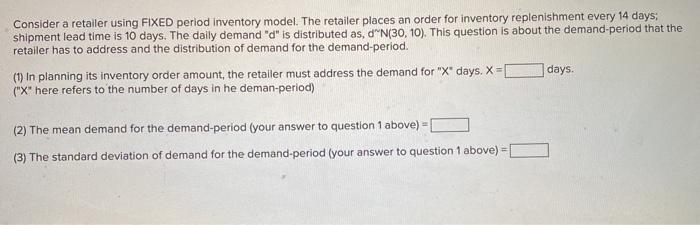
Question: Consider a retailer using FIXED period inventory model. The retailer places an order for inventory replenishment every 14 days: shipment lead time is 10 days.
Consider a retailer using FIXED period inventory
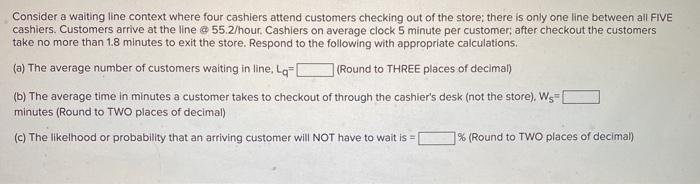
Consider a retailer using FIXED period inventory model. The retailer places an order for inventory replenishment every 14 days: shipment lead time is 10 days. The daily demand "d" is distributed as, dN(30, 10). This question is about the demand-period that the retailer has to address and the distribution of demand for the demand-period. (1) In planning its inventory order amount, the retailer must address the demand for "X" days. X = days. ("X" here refers to the number of days in he deman-period) (2) The mean demand for the demand-period (your answer to question 1 above) = [ (3) The standard deviation of demand for the demand-period (your answer to question 1 above) Consider a waiting line context where four cashiers attend customers checking out of the store; there is only one line between all FIVE cashiers. Customers arrive at the line @ 55.2/hour. Cashiers on average clock 5 minute per customer, after checkout the customers take no more than 1.8 minutes to exit the store. Respond to the following with appropriate calculations. (a) The average number of customers waiting in line, Lg- (Round to THREE places of decimal) (b) The average time in minutes a customer takes to checkout of through the cashier's desk (not the store). Ws= minutes (Round to TWO places of decimal) (c) The likelhood or probability that an arriving customer will NOT have to wait is = % (Round to TWO places of decimal)

Step by Step Solution

There are 3 Steps involved in it

1 Expert Approved Answer
Step: 1 Unlock blur-text-image

Question Has Been Solved by an Expert!

Get step-by-step solutions from verified subject matter experts

Step: 2 Unlock
Step: 3 Unlock

Students Have Also Explored These Related General Management Questions!