





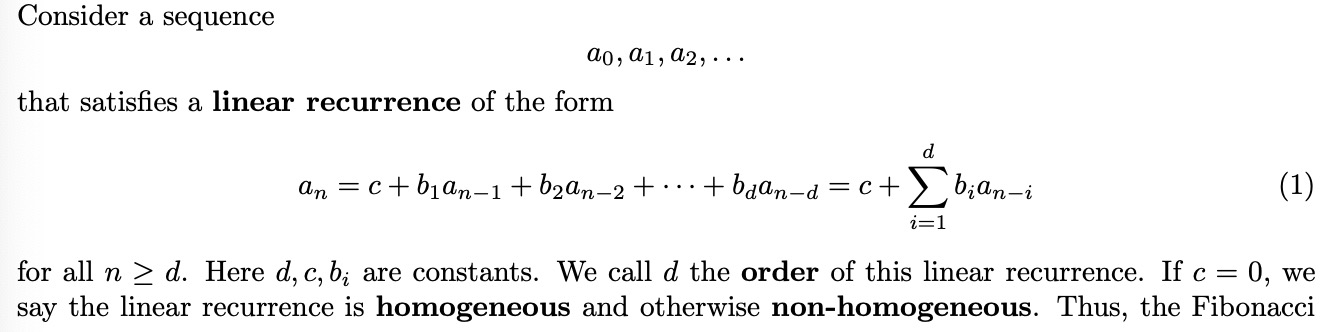
Question: Consider a sequence ao, a1, a2, . .. that satisfies a linear recurrence of the form d an = C+ blan-1 + ban-2+ . .
Consider a sequence ao, a1, a2, . .. thatConsider a sequence ao, a1, a2, . .. that
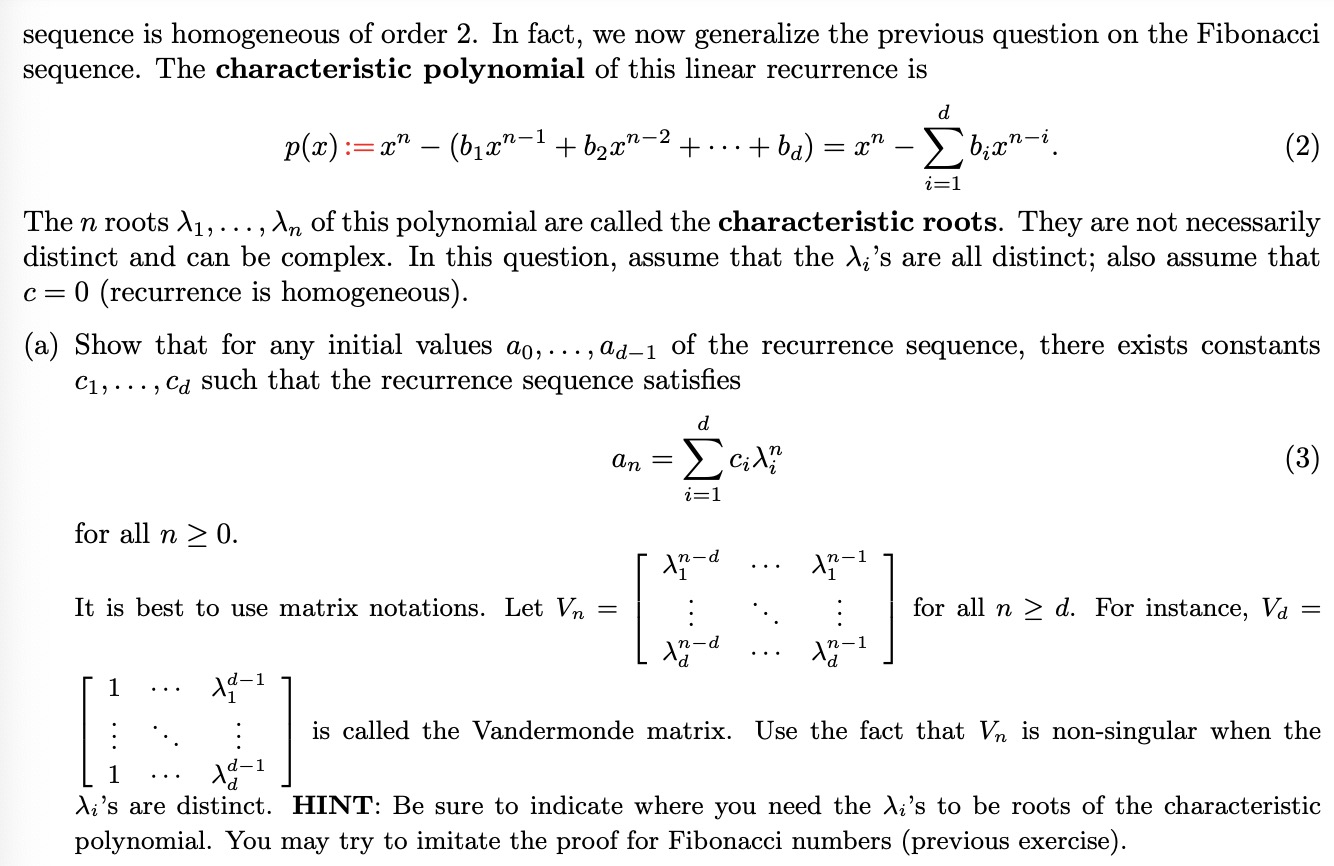
Consider a sequence ao, a1, a2, . .. that satisfies a linear recurrence of the form d an = C+ blan-1 + ban-2+ . . . + baan-d = c+ bian-i (1) i=1 for all n 2 d. Here d, c, b; are constants. We call d the order of this linear recurrence. If c = 0, we say the linear recurrence is homogeneous and otherwise non-homogeneous. Thus, the Fibonaccisequence is homogeneous of order 2. In fact, we now generalize the previous question on the Fibonacci sequence. The characteristic polynomial of this linear recurrence is a p($) :=.1':\" (Mann1 + fawn2 + - - - + bag) = a?\" Z braini. (2) i=1 The n roots A1, . . . , An of this polynomial are called the characteristic roots. They are not necessarily distinct and can be cornplex. In this question, assume that the Ai's are all distinct; also assume that c = 0 (recurrence is homogeneous). (a) Show that for any initial values (1.0,. . . ,ad_1 of the recurrence sequence, there exists constants c1, . . . ,cd such that the recurrence sequence satises a: a... = 2 05A? (3) 21 for all n 2 0. A'sd Alf1 It is best to use matrix notations. Let Vn = for all n 2 d. For instance, Va = Agd A34 1 Af'l ' . _ is called the Vandermonde matrix. Use the fact that V\" is non-singular when the 1 A'l M's are distinct. HINT: Be sure to indicate where you need the LES to be roots of the characteristic polynomial. You may try to imitate the proof for Fibonacci numbers (previous exercise)

Step by Step Solution

There are 3 Steps involved in it

1 Expert Approved Answer
Step: 1 Unlock blur-text-image

Question Has Been Solved by an Expert!

Get step-by-step solutions from verified subject matter experts

Step: 2 Unlock
Step: 3 Unlock

Students Have Also Explored These Related Mathematics Questions!