







Question: Consider a simple application distributed over four machines such that you have one load balancer, two application replicas, and one storage server. In this example
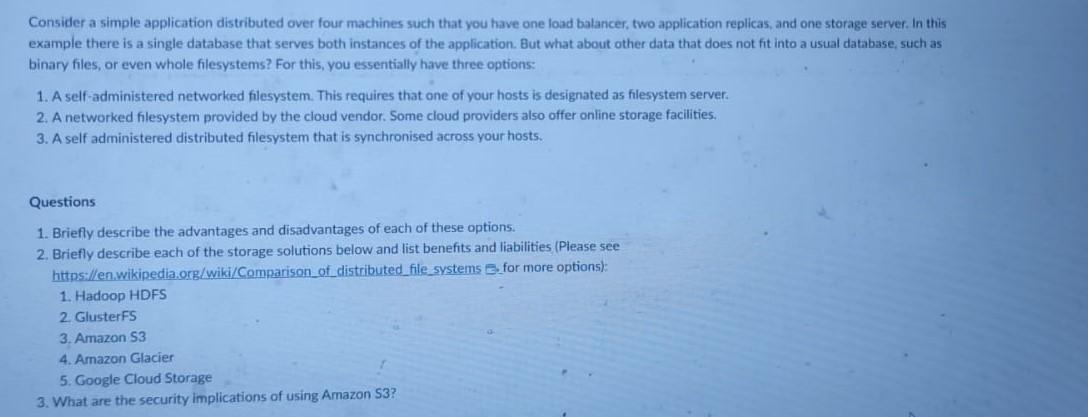
Consider a simple application distributed over four machines such that you have one load balancer, two application replicas, and one storage server. In this example there is a single database that serves both instances of the application. But what about other data that does not fit into a usual databe, such as binary files, or even whole filesystems? For this, you essentially have three options: 1. A self-administered networked filesystem. This requires that one of your hosts is designated as filesystem server. 2. A networked filesystem provided by the cloud vendor. Some cloud providers also offer online storage facilities. 3. A self administered distributed filesystem that is synchronised across your hosts. Questions 1. Briefly describe the advantages and disadvantages of each of these options. 2. Briefly describe each of the storage solutions below and list benefits and liabilities (Piease see https://en.wikipedia.org/wiki/Comparison of distributed file.systems E for more options): 1. Hadoop HDFS 2. GlusterFS 3. Armazon 53 4. Arnazon Glacier 5. Google Cloud Storage 3. What are the security implications of using Amazon S3
Step by Step Solution
There are 3 Steps involved in it

Get step-by-step solutions from verified subject matter experts
 Study Help