







Question: Consider a simple efficiency wage model. A worker's utility as a function of wages w and effort e is given by u(w.e). The worker's effort
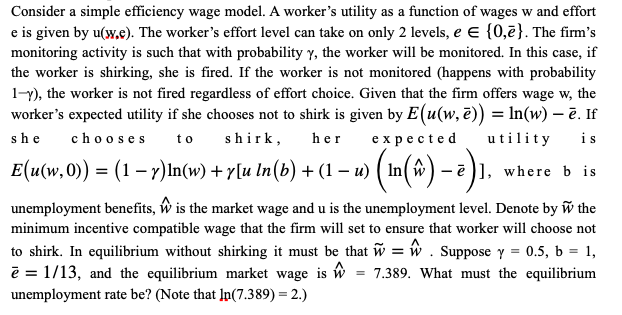
Consider a simple efficiency wage model. A worker's utility as a function of wages w and effort e is given by u(w.e). The worker's effort level can take on only 2 levels, e E {0,e}. The firm's monitoring activity is such that with probability y, the worker will be monitored. In this case, if the worker is shirking, she is fired. If the worker is not monitored (happens with probability 1-y), the worker is not fired regardless of effort choice. Given that the firm offers wage w, the worker's expected utility if she chooses not to shirk is given by E( u(w, e) ) = In(w) - e. If she chooses to shirk, her expected utility i s E(u(w, 0)) = (1 -y)In(w) + ylu In(b) + (1 -u) In w -e], where b is unemployment benefits, w is the market wage and u is the unemployment level. Denote by W the minimum incentive compatible wage that the firm will set to ensure that worker will choose not to shirk. In equilibrium without shirking it must be that w = w . Suppose y = 0.5, b = 1, e = 1/13, and the equilibrium market wage is w 7.389. What must the equilibrium unemployment rate be? (Note that In(7.389) = 2.)
Step by Step Solution
There are 3 Steps involved in it

Get step-by-step solutions from verified subject matter experts
 Study Help