







Question: Consider a simple, undirected, and connected graph G ( V , E ) . In class, we saw that in order for that graph to
Consider a simple, undirected, and connected graph In class, we saw that in order for
that graph to have an Eulerian cycle, it must have that all nodes have even degree. Answer the
following questions.
a First, assume that we can "double" an edge. That is we can duplicate it in the graph of
course, resulting in a graph that is no longer simple Consider, eg the following Figure :
oubling of an edge in a
Should we double every edge, then is our graph definitely Eulerian? That is in any graph
if we double every edge in there, does the graph always have an Eulerian cycle? Either prove
this statement or provide a counter example to it
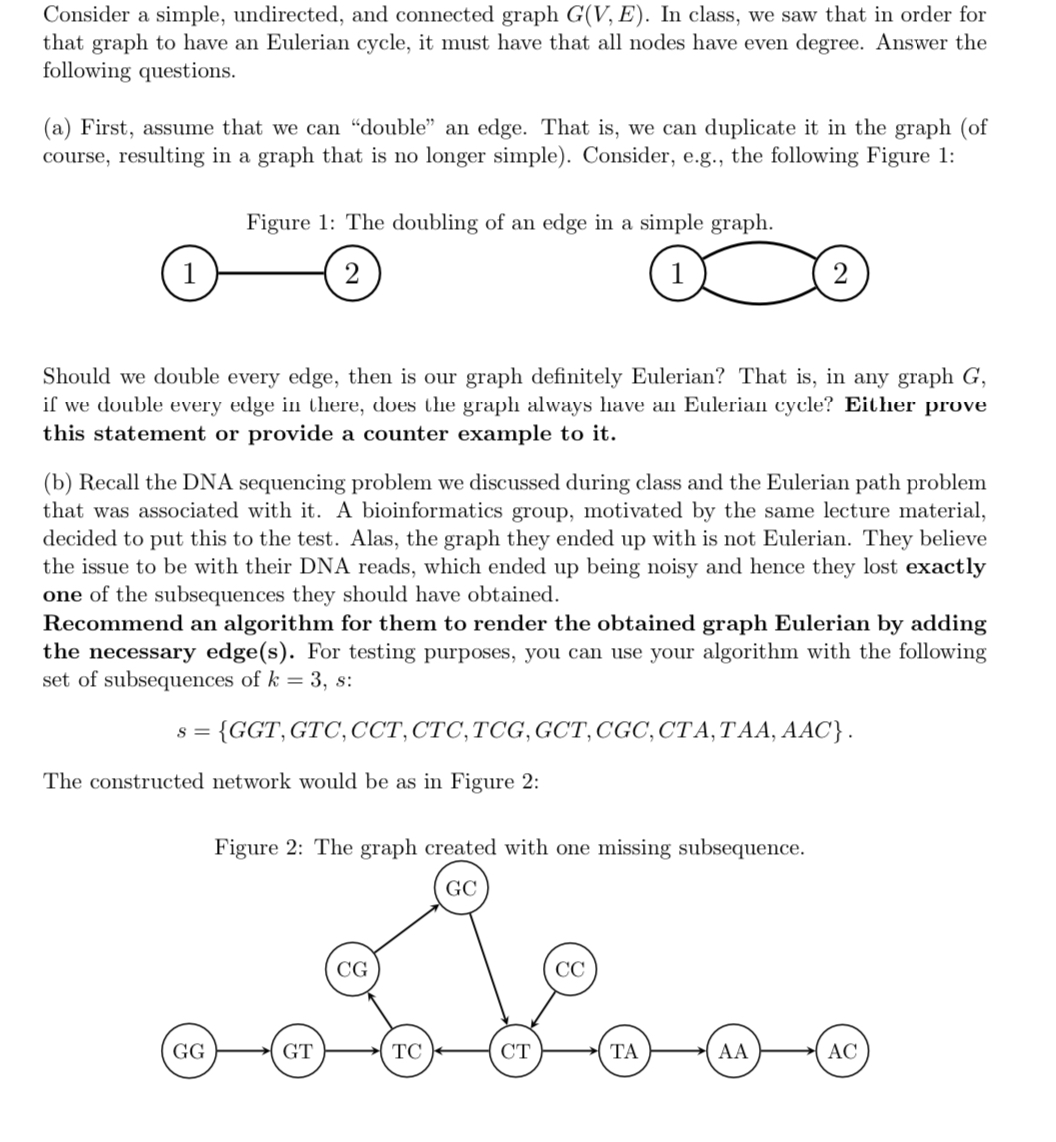
b Recall the DNA sequencing problem we discussed during class and the Eulerian path problem
that was associated with it A bioinformatics group, motivated by the same lecture material,
decided to put this to the test. Alas, the graph they ended up with is not Eulerian. They believe
the issue to be with their DNA reads, which ended up being noisy and hence they lost exactly
one of the subsequences they should have obtained.
Recommend an algorithm for them to render the obtained graph Eulerian by adding
the necessary edges For testing purposes, you can use your algorithm with the following
set of subsequences of :
CTA,TAA,AAC
The constructed network would be as in Figure :
Figure : The granh created with one missing subseauence.
Step by Step Solution
There are 3 Steps involved in it
1 Expert Approved Answer
Step: 1 Unlock

Question Has Been Solved by an Expert!
Get step-by-step solutions from verified subject matter experts
Step: 2 Unlock
Step: 3 Unlock
 Study Help