







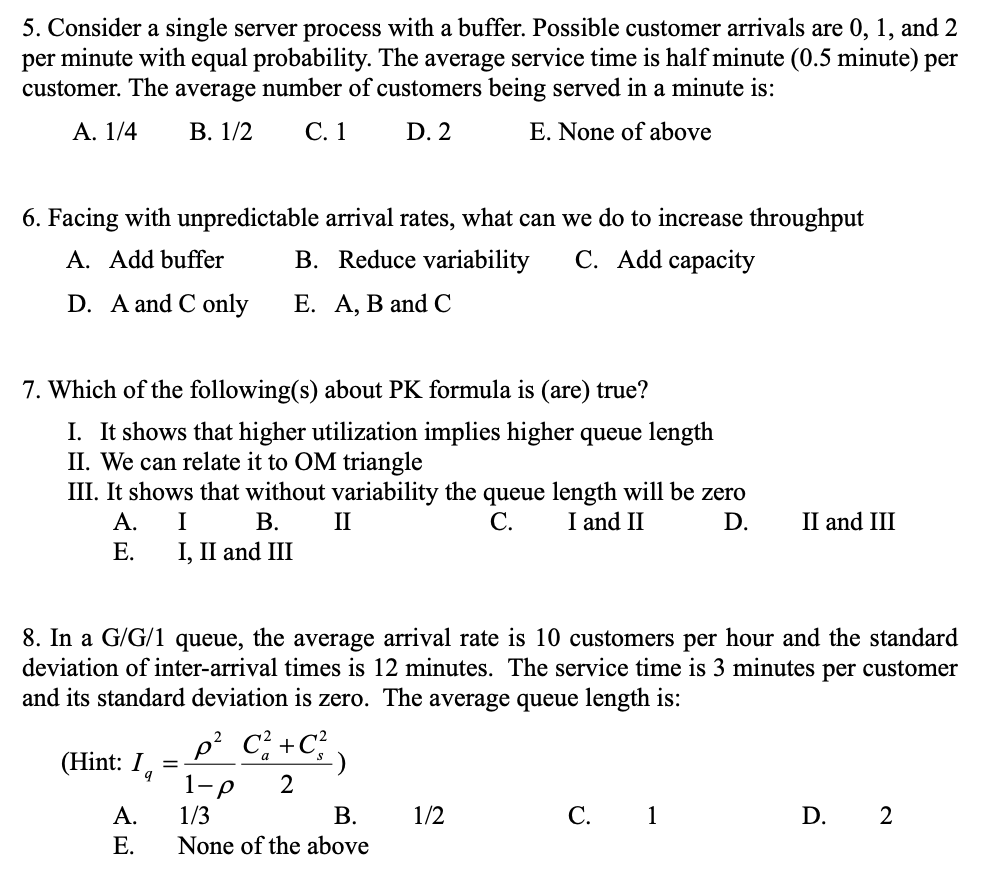
Question: Consider a single server process with a buffer. Possible customer arrivals are 0 , 1 , and 2 per minute with equal probability. The average
Consider a single server process with a buffer. Possible customer arrivals are and
per minute with equal probability. The average service time is half minute minute per
customer. The average number of customers being served in a minute is:
A
B
C
D
E None of above
Facing with unpredictable arrival rates, what can we do to increase throughput
A Add buffer
B Reduce variability
C Add capacity
D A and C only
E A B and C
Which of the followings about PK formula is are true?
I. It shows that higher utilization implies higher queue length
II We can relate it to OM triangle
III. It shows that without variability the queue length will be zero
A I
B II
C I and II
D II and III
E I, II and III
In a GG queue, the average arrival rate is customers per hour and the standard
deviation of interarrival times is minutes. The service time is minutes per customer
and its standard deviation is zero. The average queue length is:
Hint:
A
B
C
D
E None of the above
Step by Step Solution
There are 3 Steps involved in it
1 Expert Approved Answer
Step: 1 Unlock

Question Has Been Solved by an Expert!
Get step-by-step solutions from verified subject matter experts
Step: 2 Unlock
Step: 3 Unlock
 Study Help