







Question: Consider a SINGLE server system with customers that arrive to the station according to a Poisson process. The server starts offering service in normal mode,
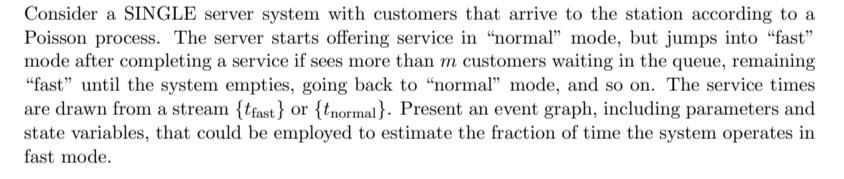
Consider a SINGLE server system with customers that arrive to the station according to a Poisson process. The server starts offering service in "normal" mode, but jumps into "fast" mode after completing a service if sees more than m customers waiting in the queue, remaining "fast" until the system empties, going back to "normal" mode, and so on. The service times are drawn from a stream {tfast} or {tnormal}. Present an event graph, including parameters and state variables, that could be employed to estimate the fraction of time the system operates in fast mode. Consider a SINGLE server system with customers that arrive to the station according to a Poisson process. The server starts offering service in "normal" mode, but jumps into "fast" mode after completing a service if sees more than m customers waiting in the queue, remaining "fast" until the system empties, going back to "normal" mode, and so on. The service times are drawn from a stream {tfast} or {tnormal}. Present an event graph, including parameters and state variables, that could be employed to estimate the fraction of time the system operates in fast mode
Step by Step Solution
There are 3 Steps involved in it
1 Expert Approved Answer
Step: 1 Unlock

Question Has Been Solved by an Expert!
Get step-by-step solutions from verified subject matter experts
Step: 2 Unlock
Step: 3 Unlock
 Study Help