







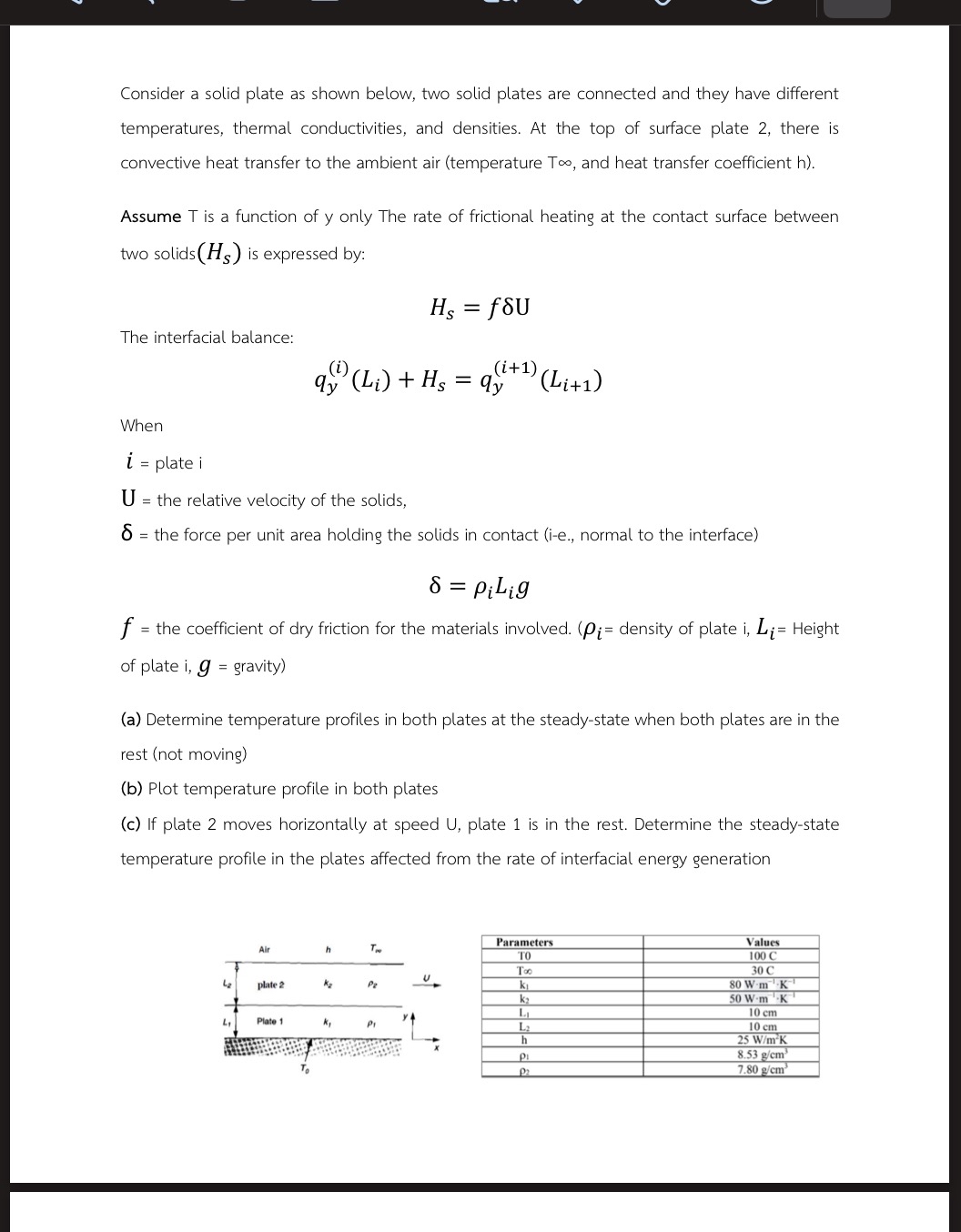
Question: Consider a solid plate as shown below, two solid plates are connected and they have different temperatures, thermal conductivities, and densities. At the top of
Consider a solid plate as shown below, two solid plates are connected and they have different
temperatures, thermal conductivities, and densities. At the top of surface plate there is
convective heat transfer to the ambient air temperature and heat transfer coefficient
Assume is a function of only The rate of frictional heating at the contact surface between
two solids is expressed by:
The interfacial balance:
When
plate
the relative velocity of the solids,
the force per unit area holding the solids in contact ie normal to the interface
the coefficient of dry friction for the materials involved. density of plate i Height
of plate i gravity
a Determine temperature profiles in both plates at the steadystate when both plates are in the
rest not moving
b Plot temperature profile in both plates
c If plate moves horizontally at speed plate is in the rest. Determine the steadystate
temperature profile in the plates affected from the rate of interfacial energy generation
Step by Step Solution
There are 3 Steps involved in it
1 Expert Approved Answer
Step: 1 Unlock

Question Has Been Solved by an Expert!
Get step-by-step solutions from verified subject matter experts
Step: 2 Unlock
Step: 3 Unlock
 Study Help