







Question: Consider a system that is driven by two Poisson point processes, A1 and A2, where Ai = {An i, n = 0,1,2,...} with respective intensity
Consider a system that is driven by two Poisson point processes, A1 and A2, where Ai = {An
i, n = 0,1,2,...} with respective intensity ?i > 0, i = 1,2. The corresponding counting processes are N_i = {Ni(t), t ? 0}, i = 1,2. The aggregate (superimposed) arriving point process is denoted as A
and its counting process is denoted as N = {N(t), t ? 0}, where N(t) = N1(t) + N2(t), t ? 0.
a. Obtain the distribution of N(t), t > 0.
b. Calculate the probability P{N1(t)=1 | N(t) = 2}, t > 0.
c. Calculate P{N(0,3t)=2 | N1(0,2t) = 2, N2(0,3t) = 1}, t > 0.
d. Calculate P{A1 > t | A11 > t, (A1)^2 > t/2}, t > 0.
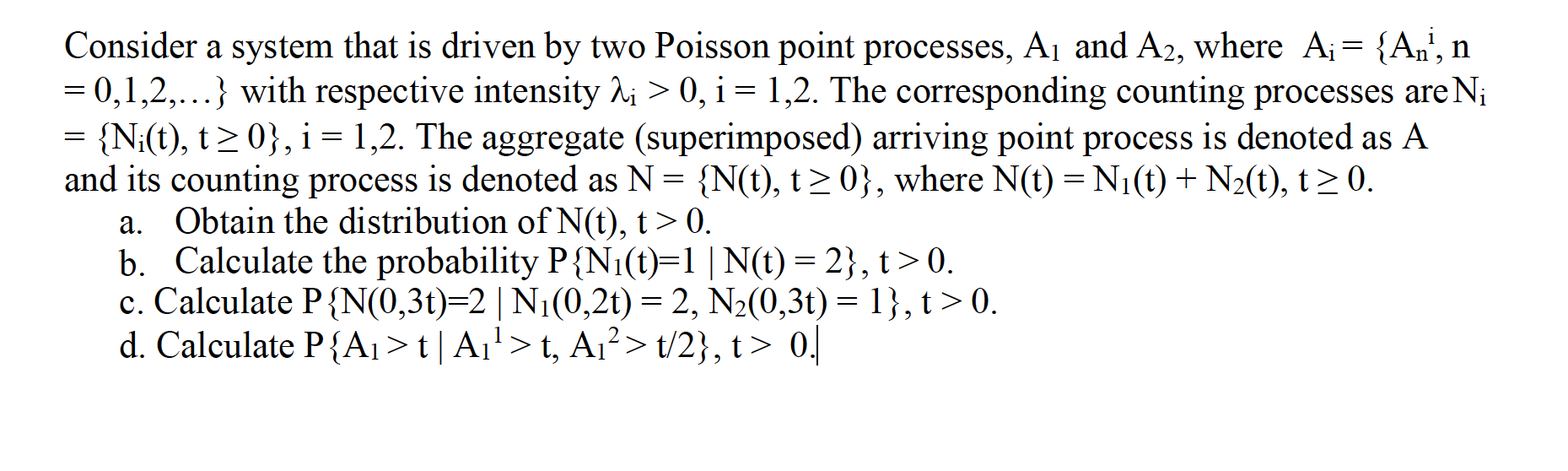
Consider a system that is driven by two Poisson point processes, A1 and A2, where Ai = {A111, 11 = O l 2 ..} With respective intensity M > 0, i = 1,2. The corresponding counting processes areNi = {Ni(t), t Z 0}, i = 1,2. The aggregate (superimposed) arriving point process is denoted as A and its counting process is denoted as N = {N(t), t Z 0}, where N(t) = N1(t) + N2(t), t 2 O. a. Obtain the distribution of N(t), t > O. b, Calculate the probability P{N1(t)=l |N(t) = 2}, t > 0. c. Calculate P{N(O,3t)=2 |N1(0,2t) = 2, N2(O,3t) = l}, t > 0. d. Calculate P{A1> t | A11> t, A12 > t/2}, t > Ol
Step by Step Solution
There are 3 Steps involved in it

Get step-by-step solutions from verified subject matter experts
 Study Help