







Question: Consider a system where we transmit the same binary signal over two different channels simultaneously. After processing, we have two random variables, r1 = s
Consider a system where we transmit the same binary signal over two different channels simultaneously. After processing, we have two random variables, r1 = s + w1 r2 = 3s + w2 where s, the signal, is either equal to +1 or ?1 with equal probability, and where w1 and w2 are two statistically independent Gaussian random variables, with zero mean and variance ? 2 W , which are also independent of s. Find: (a) The decision rule which leads to the minimum probability of error. (b) The resultant probability of error.
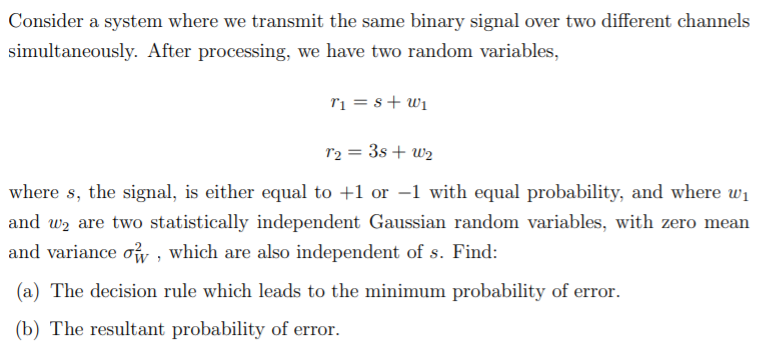
Consider a system where we transmit the same binary signal over two different channels simultaneously. After processing, we have two random variables, 71= s+ w1 12 = 3s + W2 where s, the signal, is either equal to +1 or -1 with equal probability, and where w1 and w2 are two statistically independent Gaussian random variables, with zero mean and variance ow , which are also independent of s. Find: (a) The decision rule which leads to the minimum probability of error. (b) The resultant probability of error
Step by Step Solution
There are 3 Steps involved in it

Get step-by-step solutions from verified subject matter experts
 Study Help