







Question: Consider a system with three input signals x , y and max and one output signal z . All signals are binary encoded non -
Consider a system with three input signals and max and one output signal All signals are binary encoded nonnegative integers.
System specification:
if belongs to the interval max, then ;
if max, then max;
if then
Assume that a procedure difference has been previously defined, where and are nonnegative integers and is a bit number, so that it computes
the difference under the form s is the sign and is the absolute value of the result
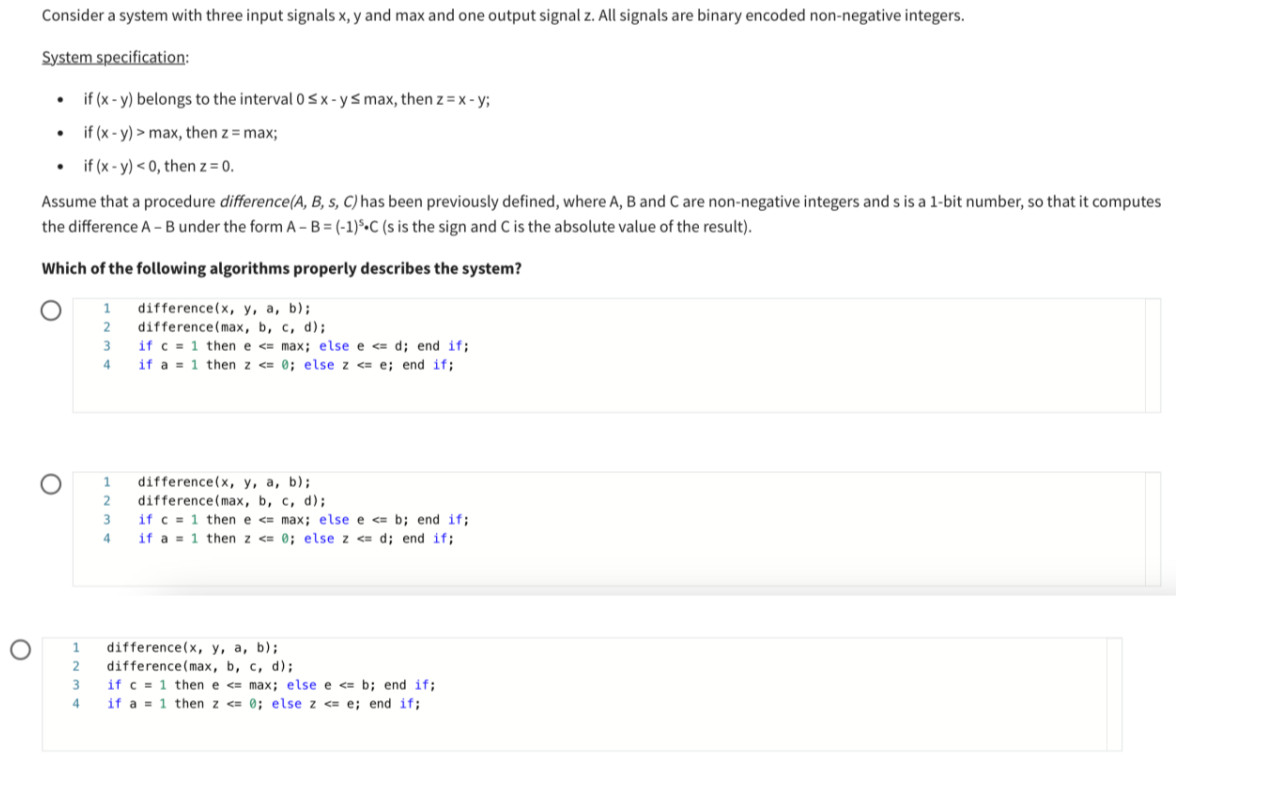
Which of the following algorithms properly describes the system?
difference ;
difference max b c d;
if then max; else ; end if;
if then ; else ; end if;
difference ;
differencemax b c d;
if then max; else ; end if;
if then ; else ; end if;
difference ;
difference max b c d;
if then max; else ; end if;
if then ; else ; end if;
Consider a system with three input signals and max and one output signal All signals are binary encoded nonnegative integers.
System specification:
if belongs to the interval max, then ;
if max, then max;
if then
Assume that a procedure difference has been previously defined, where and are nonnegative integers and is a bit number, so that it computes
the difference under the form s is the sign and is the absolute value of the result
Which of the following algorithms properly describes the system?
difference ;
difference max b c d;
if then max; else ; end if;
if then ; else ; end if;
difference ;
differencemax b c d;
if then max; else ; end if;
if then ; else ; end if;
difference ;
difference max b c d;
if then max; else ; end if;
if then ; else ; end if;
Step by Step Solution
There are 3 Steps involved in it
1 Expert Approved Answer
Step: 1 Unlock

Question Has Been Solved by an Expert!
Get step-by-step solutions from verified subject matter experts
Step: 2 Unlock
Step: 3 Unlock
 Study Help