



Question: Consider a three-city airline network from A to C with a stop at B. There are two classes per itinerary, with the fares and expected
Consider a three-city airline network from A to C with a stop at B. There are two classes per itinerary, with the fares and expected ODF demands shown in the following table:
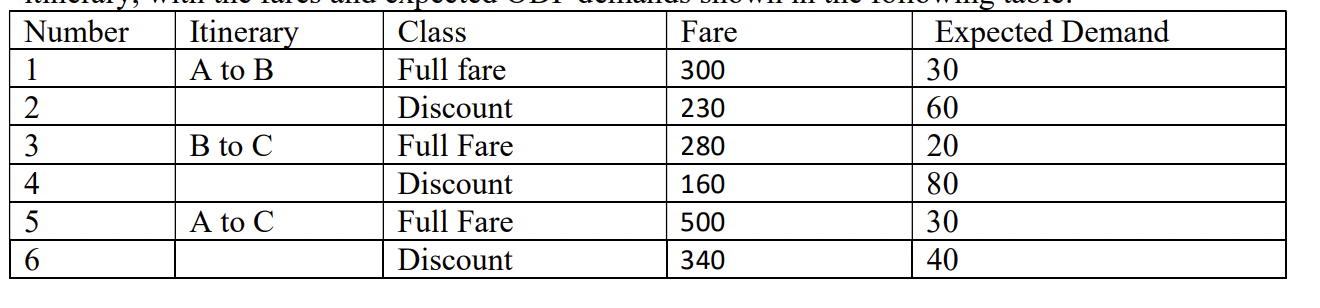
The airline has 100 seats on the leg from A to B, and 120 seats on the leg from B to C.
a) Suppose that the airline company wants to use the deterministic linear programming method to determine the partitioned booking limits. Formulate this problem as a linear program, and solve it using Excel.
b) Suppose that the airline company wants to use virtual nesting method to determine the nested booking limits. The manager decides that each leg (A to B, and B to C) has three buckets, defined as follows: Bucket 1: Net leg fares > 275 Bucket 2: Net leg fares between 200 and 275 Bucket 3: Net leg fares
c) Given the indexed buckets for the leg from A to B in part b), use EMSR-b to find the nested booking limits for this leg. Assume all ODFs demands follow normal distribution with standard deviation equal to 5. (Hint: the fare price for the bucket is the mean demand weighted average net leg fare.)
Itinerary A to B Fare 300 230 Number 1 2 3 4. 5 6 B to C Class Full fare Discount Full Fare Discount Full Fare Discount 280 Expected Demand 30 60 20 80 30 40 160 A to C 500 340
Step by Step Solution
There are 3 Steps involved in it

Get step-by-step solutions from verified subject matter experts