



Question: Consider a three-way Nash bargaining situation: parties A, B, and C may split $1 between them if all three agree to a deal, or else
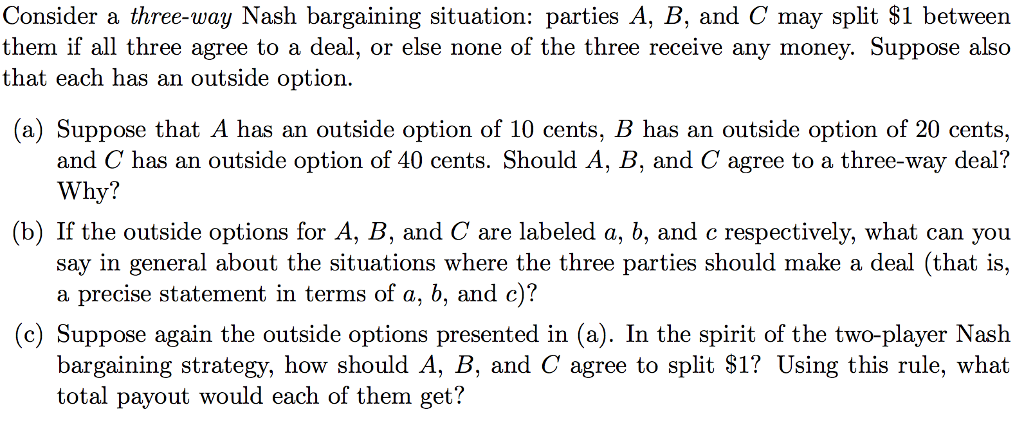
Consider a three-way Nash bargaining situation: parties A, B, and C may split $1 between them if all three agree to a deal, or else none of the three receive any money. Suppose also that each has an outside option. (a) Suppose that A has an outside option of 10 cents, B has an outside option of 20 cents, and C has an outside option of 40 cents. Should A, B, and C agree to a three-way deal? Why? (b) If the outside options for A, B, and C are labeled a, b, and c respectively, what can you say in general about the situations where the three parties should make a deal (that is, a precise statement in terms of a, b, and c)? (c) Suppose again the outside options presented in (a). In the spirit of the two-player Nash bargaining strategy, how should A, B, and C agree to split S1? Using this rule, what total payout would each of them get? Consider a three-way Nash bargaining situation: parties A, B, and C may split $1 between them if all three agree to a deal, or else none of the three receive any money. Suppose also that each has an outside option. (a) Suppose that A has an outside option of 10 cents, B has an outside option of 20 cents, and C has an outside option of 40 cents. Should A, B, and C agree to a three-way deal? Why? (b) If the outside options for A, B, and C are labeled a, b, and c respectively, what can you say in general about the situations where the three parties should make a deal (that is, a precise statement in terms of a, b, and c)? (c) Suppose again the outside options presented in (a). In the spirit of the two-player Nash bargaining strategy, how should A, B, and C agree to split S1? Using this rule, what total payout would each of them get
Step by Step Solution
There are 3 Steps involved in it

Get step-by-step solutions from verified subject matter experts