



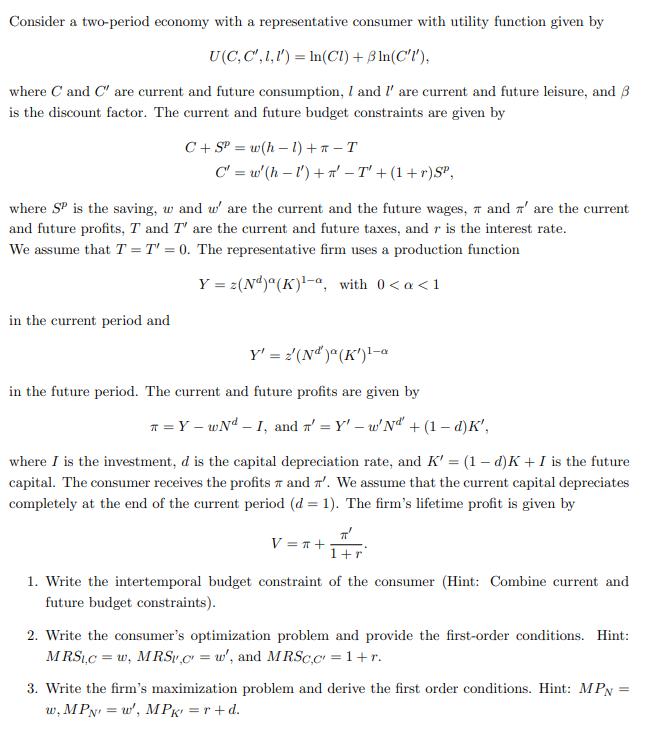
Question: Consider a two-period economy with a representative consumer with utility function given by U(C, C', 1,1') = n(Cl) + 3 ln(C'1'), where C and
![in the current period and [ Y^{prime}=z^{prime}left(N^{d^{prime}}ight)^{alpha}left(K^{prime}ight)^{1-alpha} ] i](https://dsd5zvtm8ll6.cloudfront.net/si.experts.images/questions/2022/12/6392c6ada5e73_1670563500655.jpg)
Consider a two-period economy with a representative consumer with utility function given by U(C, C', 1,1') = n(Cl) + 3 ln(C'1'), where C and C' are current and future consumption, I and l' are current and future leisure, and 3 is the discount factor. The current and future budget constraints are given by C+SP=w(h-1) + -T in the current period and C'= w' (h-l') + '-T' + (1+r)SP, where SP is the saving, w and w' are the current and the future wages, 7 and ' are the current and future profits, T and T' are the current and future taxes, and r is the interest rate. We assume that T = T' = 0. The representative firm uses a production function Y = 2(Nd)a(K)-a, with 0 in the current period and Y' = (Nd)a(K)-a in the future period. The current and future profits are given by = Y - wNd - I, and n' = Y' -w'Nd" + (1 -d)K', where I is the investment, d is the capital depreciation rate, and K' = (1-d)K + I is the future capital. The consumer receives the profits and '. We assume that the current capital depreciates completely at the end of the current period (d=1). The firm's lifetime profit is given by V=T + T' 1+r . 1. Write the intertemporal budget constraint of the consumer (Hint: Combine current and future budget constraints). 2. Write the consumer's optimization problem and provide the first-order conditions. Hint: MRSLC = w, MRS.C=w', and MRSC,c = 1 + r. 1 3. Write the firm's maximization problem and derive the first order conditions. Hint: MPN = w, MPN = w', MPK =r+d. 4. Define the competitive equilibrium. 5. Using the production function, eliminate K and K' from the first-order conditions for Nd and N. Proceed similarly to eliminate Nd' from the firm's first order condition for I. 6. Combine the consumer and the firms first order conditions by eliminating the wages and the interest rate. 7. Show that in the competitive equilibrium, we have N = Nd = N, Ns' = Nd' = N', and C = (1-2)Y, where z is a constant. Calculate N and N' using the first-order conditions.
Step by Step Solution
3.53 Rating (163 Votes )
There are 3 Steps involved in it
1The intertemporal budget constraint of the consumer can be obtained by combining the current and future budget constraints C Sp wh l pi 1 r Sp wprimeh lprime piprime 2The consumers optimization probl... View full answer

Get step-by-step solutions from verified subject matter experts